

FROM UNBUILT CONCEPT TO CREDIBLE EXPERIENCE
Before A Building Can Be Built, It Has To Be Understood.
Architectural visualization closes the distance between technical intention and human understanding—giving an unbuilt project form, atmosphere, scale, and credibility before physical reality can do the work.
An architectural idea can be rigorous on paper and still remain difficult to fully understand. Drawings, plans, sections, specifications, and technical descriptions communicate essential information, but they do not always reveal how a space may actually feel, how materials interact with light, or how architecture will sit within its future environment.
This is where 3D visualization becomes more than representation. It translates spatial information into an experience people can evaluate more intuitively, helping architects, clients, investors, and other decision-makers see relationships that may otherwise require specialist knowledge or significant imagination to interpret.
The strongest architectural visualization does not simply make a project look impressive. It brings together spatial clarity, material credibility, atmosphere, context, and visual storytelling so that an idea begins to feel coherent before it exists physically.
When those elements work together, visualization can help move a project from abstract possibility toward something much more powerful: an idea that can already be understood, discussed, evaluated, and believed in.
BEFORE ARCHITECTURE BECOMES PHYSICAL, VISUALIZATION GIVES PEOPLE A WAY TO EXPERIENCE THE IDEA THAT COMES FIRST.
FROM SPATIAL INFORMATION TO HUMAN CONVICTION
What Makes An Unbuilt Idea Feel Real Enough To Believe In
Clarity. Realism. Atmosphere. Conviction. Application.
A convincing visualization is not created by realism alone. It depends on how successfully the image translates architectural intent into a visual experience that people can understand without losing the logic, character, and spatial relationships behind the design.
Clarity establishes what the viewer needs to understand. Realism makes materials, light, scale, and physical relationships feel credible. Atmosphere gives the space emotional character. Conviction emerges when those elements work together strongly enough for the unbuilt project to feel plausible rather than hypothetical. Application determines whether the visualization can communicate effectively beyond the image itself—in presentations, design discussions, approvals, marketing, or investment contexts.
These dimensions are interconnected. A technically accurate image can remain emotionally flat. A dramatic image can become less persuasive when scale, materials, or context feel inconsistent. A photorealistic render may attract attention while still failing to explain the architectural idea clearly.
The strongest visualization therefore does not ask only:
Does this look real?
It asks a more important question:
Does this image make the project easier to understand, easier to believe in, and more meaningful to the people who need to respond to it?
A GREAT VISUALIZATION DOES NOT MERELY SHOW THE FUTURE. IT MAKES THE FUTURE FEEL CLEAR ENOUGH TO DISCUSS, CREDIBLE ENOUGH TO TRUST, AND REAL ENOUGH TO IMAGINE YOURSELF INSIDE IT.
01 —
CLARITY BEFORE IMPRESSION
WHY IT MATTERS
Before visualization can persuade, it has to make the architectural idea easier to understand.
A 3D image may contain the correct geometry, proportions, materials, and camera position while still communicating very little about the actual experience of the project. When the viewer sees only a building placed inside a generic environment, the image may describe what exists in the model without explaining what makes the architecture meaningful.
Strong architectural visualization begins by identifying what the viewer should understand first—form, scale, spatial relationships, circulation, material character, connection to context, or the atmosphere the design is intended to create.
The objective is not to overload the image with information. It is to establish enough visual hierarchy and spatial clarity that the project can be understood without requiring the viewer to reconstruct the architectural idea mentally.
COMMON FAILURE
The geometry is visible, but the architectural intention is not.
A basic render can show walls, openings, roofs, materials, and overall massing while leaving the viewer with no clear sense of scale, atmosphere, context, or spatial experience.
The problem is not necessarily technical accuracy. The problem is that accuracy alone does not determine what the viewer notices, understands, or remembers.
When every element is presented with similar visual importance, the render becomes documentation of the model rather than communication of the design.
When A Render Shows The Building But Not The Architectural Idea
WHY THIS EXAMPLE MATTERS
This visualization makes the basic form of the building understandable, but most of the image remains descriptive rather than experiential.
The architecture is presented against a simplified environment with limited material depth, atmospheric variation, contextual information, or visual hierarchy. The viewer can identify the building, but receives very little guidance about how the space should feel, what makes the design distinctive, or how the architecture relates to its surroundings.
This distinction matters because a technically readable model is not automatically an effective architectural presentation.
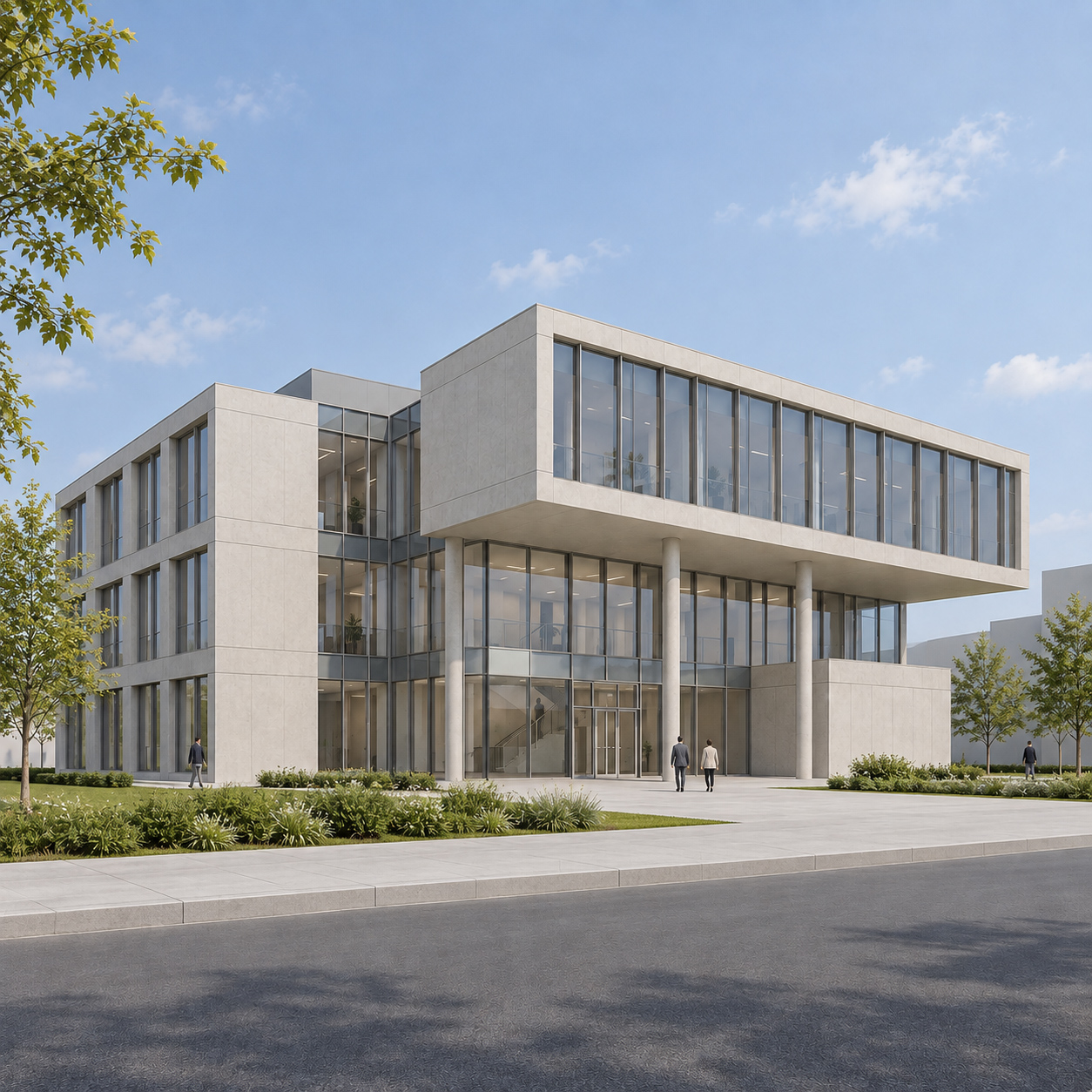
WHAT NOT TO DO — Showing Geometry Without Enough Spatial Or Experiential Communication
A render can describe the form accurately while still leaving the architectural character, atmosphere, and intended experience largely unresolved.
BETTER
DIRECTION
Build the visualization around what the viewer needs to understand about the architecture and how those relationships should be perceived, not simply around everything that exists inside the model.
Architectural Intent → Visual Priority → Spatial Relationships → Context → Experience
A useful visualization should establish a clear hierarchy between the building, its environment, and the information that supports the design.
Camera position should reveal meaningful spatial relationships rather than merely fit the complete object into the frame.
Light should help explain depth, materiality, orientation, and atmosphere.
Context should clarify how the architecture occupies the site rather than functioning as decorative background.
Material definition should support the character of the design without becoming visual noise.
And every decision should contribute to one larger question:
What should the viewer understand about this project before anything else?
When that question is answered clearly, visualization stops behaving like a screenshot of a 3D model and begins functioning as architectural communication.
PROJECT
EVIDENCE
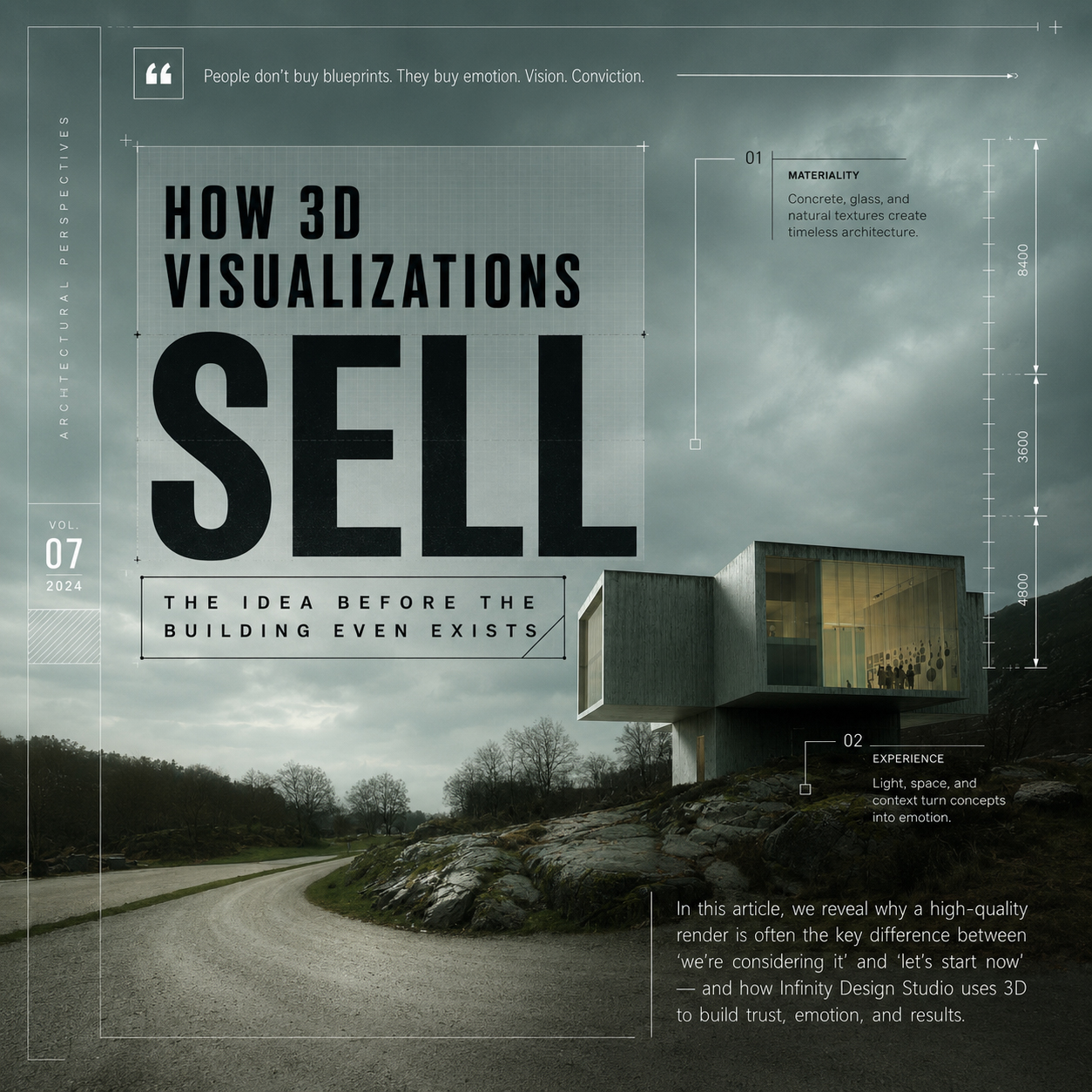
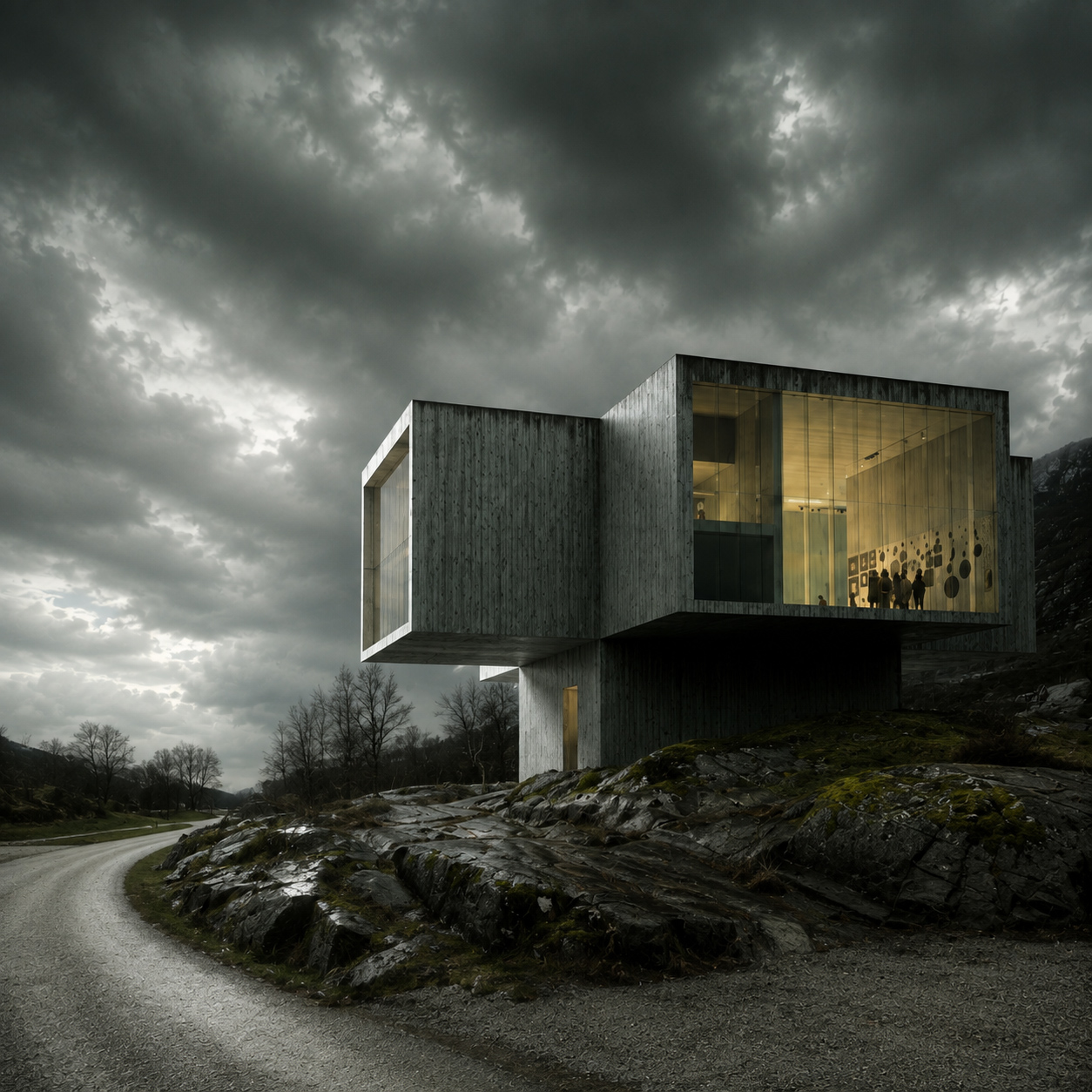
The architectural visualization shown here demonstrates how the same fundamental medium can move beyond simple representation and begin communicating space, atmosphere, material character, environmental relationship, and emotional tone simultaneously.
The architecture remains immediately identifiable, but it is no longer isolated from the conditions that give it meaning. The rocky terrain, changing elevation, road, vegetation, dramatic sky, natural light, and illuminated interior establish a believable relationship between the building and its environment.
The composition also creates a clear hierarchy. The viewer understands the architecture first, then begins reading its relationship to the landscape, the contrast between exterior and interior, and the atmosphere surrounding the project.
The scene also demonstrates how hierarchy can be built through sequence rather than spectacle. The eye first recognizes the architecture, then discovers the site, the access route, the illuminated interior, and finally the atmosphere connecting them. That progression gives the viewer a way to read the project gradually, making the image feel both controlled and believable.
The image does not simply present an object. It establishes a situation in which the architecture can already be imagined as part of a real place and a future experience.
When Visualization Makes Architectural Intent Easier To Understand
WHY THIS EXAMPLE MATTERS
The building remains the central subject, but the surrounding visual information helps explain far more than its geometry.
Light reveals material depth and interior occupation. Landscape establishes scale and environmental relationship. The road creates spatial orientation and leads the eye toward the architecture. Atmospheric conditions give the scene character while reinforcing the contrast between the exterior environment and the illuminated interior.
Together, these elements transform the image from a representation of form into a more complete explanation of how the architecture may exist, feel, and be experienced.
PROJECT EVIDENCE
Architectural Visualization Built Around Clarity, Context, And Spatial Experience
A coordinated use of composition, light, materiality, landscape, and atmosphere helps translate an unbuilt architectural concept into something the viewer can understand more intuitively.
A RENDER BECOMES MORE VALUABLE WHEN IT DOES MORE THAN SHOW WHAT WAS MODELED.
IT SHOULD REVEAL WHAT THE ARCHITECTURE IS TRYING TO BECOME.
02 —
BELIEVABILITY BEFORE PHOTOREALISM
WHY IT MATTERS
Photorealism is not simply a matter of adding sharper textures, stronger reflections, or more detailed materials.
A visualization becomes believable when light, scale, material response, surface variation, depth, and physical relationships behave as though they belong to the same world.
The viewer may never consciously analyze those elements individually. But when something is inconsistent—a material reflects too perfectly, an object feels weightless, shadows do not support the light source, or every surface appears equally clean—the image begins to reveal the simulation behind it.
That is why the strongest architectural visualization does not pursue perfection for its own sake. It pursues coherence.
The goal is not to make every surface spectacular. It is to make the complete scene feel physically plausible enough that attention can move beyond the rendering technique and toward the architecture itself.
COMMON FAILURE
The image contains detail, but the world does not feel physically convincing.
A technically polished render can still feel artificial when materials behave independently from their environment.
Perfectly uniform surfaces, excessive gloss, exaggerated reflections, identical sharpness across the frame, unrealistic vegetation, or lighting that does not respond naturally to geometry can make the image appear more processed rather than more believable.
The problem is rarely a lack of detail.
It is usually a lack of agreement between details.
When Photorealistic Detail Still Fails To Create Believability
WHY THIS EXAMPLE MATTERS
The image may contain high-resolution materials, reflections, vegetation, and detailed geometry, yet those elements do not automatically create a convincing physical environment.
When surfaces appear too uniform, reflections become visually dominant, lighting feels disconnected from material behavior, or every element receives the same level of visual perfection, the render can become technically impressive while still feeling unmistakably artificial.
Believability emerges when individual details behave as parts of one physical system rather than as isolated demonstrations of rendering quality.

WHAT NOT TO DO — Technical Detail Without Consistent Physical Behavior
More texture, reflection, and surface detail do not automatically produce realism when light, material response, scale, and environmental interaction do not feel naturally connected.
BETTER
DIRECTION
Build realism through relationships, not through effects.
Light → Material Response → Scale → Surface Variation → Physical Contact → Visual Coherence
Concrete should respond differently from glass.
Fabric should absorb light differently from polished stone.
Objects should feel anchored by contact shadows rather than floating above surfaces.
Reflections should describe material properties without becoming the subject of the image.
Small variations in texture, roughness, color, edge condition, and surface response can prevent an otherwise accurate scene from feeling mechanically perfect.
And depth should be controlled through focus, contrast, atmosphere, and lighting rather than by giving every object identical visual importance.
The objective is not to imitate photography by adding photographic effects.
It is to create enough physical consistency that the viewer stops questioning the image and begins responding to the space.
PROJECT
EVIDENCE
The interior visualization provides a useful example because its credibility does not depend on dramatic architecture or spectacular visual effects.
Instead, the image works through controlled material relationships and familiar physical cues.
The softness of the upholstered chair contrasts with the harder floor surface and cabinetry. The plant introduces irregular organic detail. Fabric, timber, painted wall surfaces, glass, metal, and decorative objects respond differently to the same environment rather than sharing one artificial material language.
Scale is also reinforced through recognizable everyday objects—the chair, books, clock, cushions, lighting fixtures, cabinetry, and framed artwork—which helps the viewer understand the room almost instinctively.
Subtle imperfections also strengthen credibility. Small differences in texture, alignment, softness, and surface response prevent the scene from feeling manufactured, helping the environment read as naturally inhabited rather than digitally assembled.
Nothing needs to announce itself as “photorealistic.”
Realism comes from the fact that individual parts behave convincingly together.
When Material Behavior Makes A Render Feel Naturally Believable
WHY THIS EXAMPLE MATTERS
This interior visualization demonstrates how realism can emerge through restraint rather than spectacle.
Different surfaces respond to light with different levels of softness, reflection, texture, and contrast. Familiar objects establish scale, while subtle variation across furniture, vegetation, flooring, fabrics, and decorative elements prevents the scene from feeling mechanically uniform.
The result is not convincing because every object demands attention. It is convincing because the complete environment follows a coherent visual and physical logic.
That coherence allows the viewer to focus less on how the image was produced and more on the space being presented.

PROJECT EVIDENCE
Interior Visualization Built Through Material Credibility And Physical Coherence
A believable environment emerges when light, texture, scale, surface response, and familiar spatial cues work together rather than competing for attention.
REALISM IS MOST POWERFUL WHEN THE VIEWER STOPS NOTICING THE RENDERING AND STARTS BELIEVING IN THE SPACE.
03 —
ATMOSPHERE BEFORE SPECTACLE
WHY IT MATTERS
Architecture is never experienced as geometry alone.
Light, weather, time of day, shadow, color temperature, landscape, camera position, and the relationship between interior and exterior all influence how a space is perceived long before the viewer begins consciously analyzing the design.
That makes atmosphere one of the most powerful tools in architectural visualization—but also one of the easiest to misuse.
A dramatic sky, cinematic lighting, fog, reflections, or artificial glow can make an image visually impressive without making the architecture more meaningful. When atmosphere exists only to create spectacle, the image may become memorable while the design itself becomes secondary.
Strong visualization uses atmosphere differently. It allows environmental conditions to reinforce the architectural idea, reveal spatial character, establish emotional tone, and help the viewer imagine what it might actually feel like to inhabit the project.
COMMON FAILURE
The mood is stronger than the architecture.
Visualization can become overly cinematic when lighting, weather, color grading, lens effects, or dramatic contrast begin competing with the project they are supposed to support.
A spectacular sunset may dominate the composition.
Excessive interior glow can make the building feel theatrical rather than credible.
Heavy fog, exaggerated reflections, or extreme contrast may create immediate impact while obscuring material relationships, scale, and spatial information.
The problem is not atmosphere itself.
The problem begins when atmosphere becomes an effect placed on top of the architecture instead of an experience emerging from it.
When Cinematic Atmosphere Begins To Compete With The Architecture
WHY THIS EXAMPLE MATTERS
Dramatic lighting and environmental effects can immediately increase visual impact, but stronger atmosphere does not automatically create a stronger architectural presentation.
When sky, reflections, interior illumination, contrast, or post-production effects become the most dominant elements in the image, the viewer may respond to the mood before understanding the space that created it.
Atmosphere becomes valuable when it helps reveal architectural character—not when the architecture becomes a background for visual spectacle.

WHAT NOT TO DO — Atmospheric Effects That Become More Important Than The Space
Cinematic treatment can strengthen an architectural visualization, but when mood dominates form, materiality, scale, and spatial relationships, the image begins selling the effect rather than the design.
BETTER
DIRECTION
Use atmosphere to interpret the architecture, not decorate it.
Architectural Character → Light → Environment → Camera → Emotional Tone → Experience
The time of day should support the story the project needs to communicate.
Interior illumination can reveal occupation, depth, and the relationship between inside and outside rather than simply creating visual contrast.
Weather conditions can reinforce material character and environmental context.
Landscape should contribute scale, orientation, and a sense of place.
Camera height and perspective should place the viewer in a meaningful relationship with the architecture rather than searching only for the most dramatic angle.
And color grading should unify the experience without making the rendering treatment more recognizable than the project itself.
The objective is not to eliminate emotion.
It is to make emotion feel like a consequence of the architecture.
PROJECT
EVIDENCE
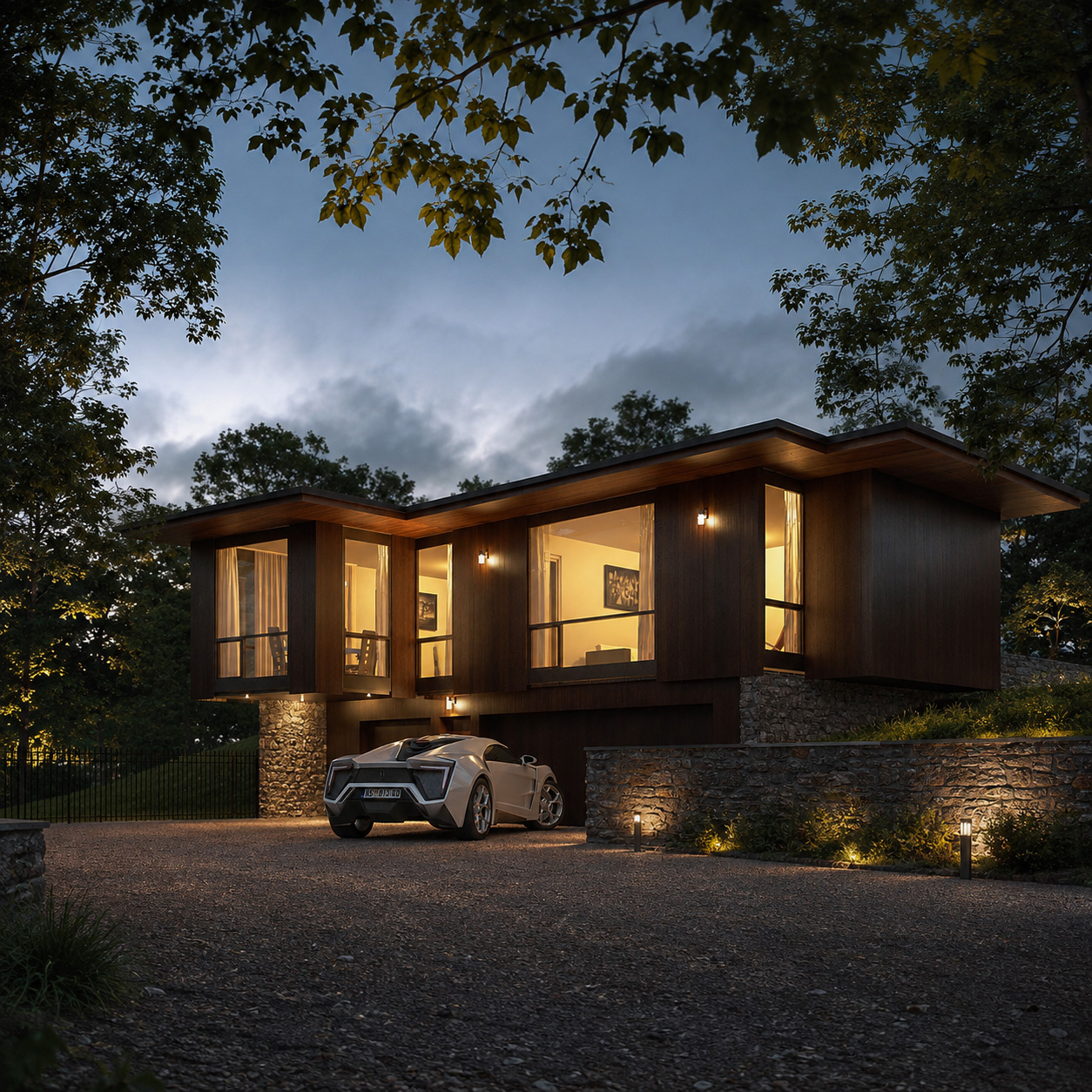
The exterior visualization used throughout this article demonstrates how atmosphere can become part of the architectural narrative rather than an independent visual effect.
The overcast landscape creates a restrained, almost quiet exterior world, while the illuminated interior introduces warmth, occupation, and human presence.
That contrast immediately establishes a relationship between shelter and exposure, interior and landscape, architecture and environment.
The curved road does more than lead the eye toward the building.
It creates distance and approach, allowing the project to be perceived gradually rather than presented as an isolated object.
The rocky terrain reinforces the physical character of the site, while the restrained palette allows the warm interior light to become a meaningful focal point rather than simply another dramatic effect.
The atmosphere therefore does not hide the architecture.
It gives the architecture an emotional context in which its spatial character becomes easier to imagine.
When Atmosphere Helps The Viewer Feel The Architecture Before It Exists
WHY THIS EXAMPLE MATTERS
This visualization uses weather, landscape, lighting, and composition to create emotion without allowing those elements to overpower the architectural subject.
The subdued exterior environment makes the illuminated interior more significant, suggesting occupation and human presence while revealing depth behind the glazed façade.
The surrounding terrain establishes scale and place, while the approaching road creates a natural visual sequence toward the project.
Together, these elements create an image that does more than present the building. They help the viewer imagine what approaching, entering, and experiencing the architecture might actually feel like.
PROJECT EVIDENCE
Architectural Atmosphere Built Around Light, Context, And Human Experience
A controlled relationship between environment, illumination, landscape, camera position, and architectural form transforms visualization from a description of space into an experience of place.
THE STRONGEST ATMOSPHERE DOES NOT DISTRACT FROM THE ARCHITECTURE.
IT MAKES THE ARCHITECTURE EASIER TO FEEL.
04 —
CONVICTION BEFORE DECISION
WHY IT MATTERS
Architectural visualization becomes strategically valuable when it helps people move from simply seeing a proposal to understanding it well enough to respond.
Clients, investors, collaborators, and other decision-makers rarely evaluate architecture through a single image alone. They need to understand how form, scale, spatial relationships, materials, circulation, context, and design intent connect into one coherent proposal.
This is where visualization can become more than presentation. It can create a shared visual reference that makes an unbuilt project easier to discuss, compare, question, refine, and ultimately evaluate.
The stronger that connection becomes, the less the conversation depends on assumption.
A convincing image may attract attention, but conviction grows when the viewer feels that what they are seeing is supported by enough spatial and architectural logic to be taken seriously.
COMMON FAILURE
The image looks persuasive, but the project remains difficult to evaluate.
A visualization can be visually polished while still leaving important questions unresolved.
Scale may be unclear.
Spatial relationships may be difficult to interpret.
The image may reveal only one carefully controlled angle while hiding how the project actually works.
Material choices may feel attractive without being connected to a broader architectural logic.
And when presentation relies entirely on one dramatic image, the viewer may understand the mood of the proposal without understanding enough of the project behind it.
The problem is not that every visualization must become a technical drawing.
The problem begins when visual persuasion is disconnected from architectural evidence.
When One Powerful Render Is Asked To Explain The Entire Project
WHY THIS EXAMPLE MATTERS
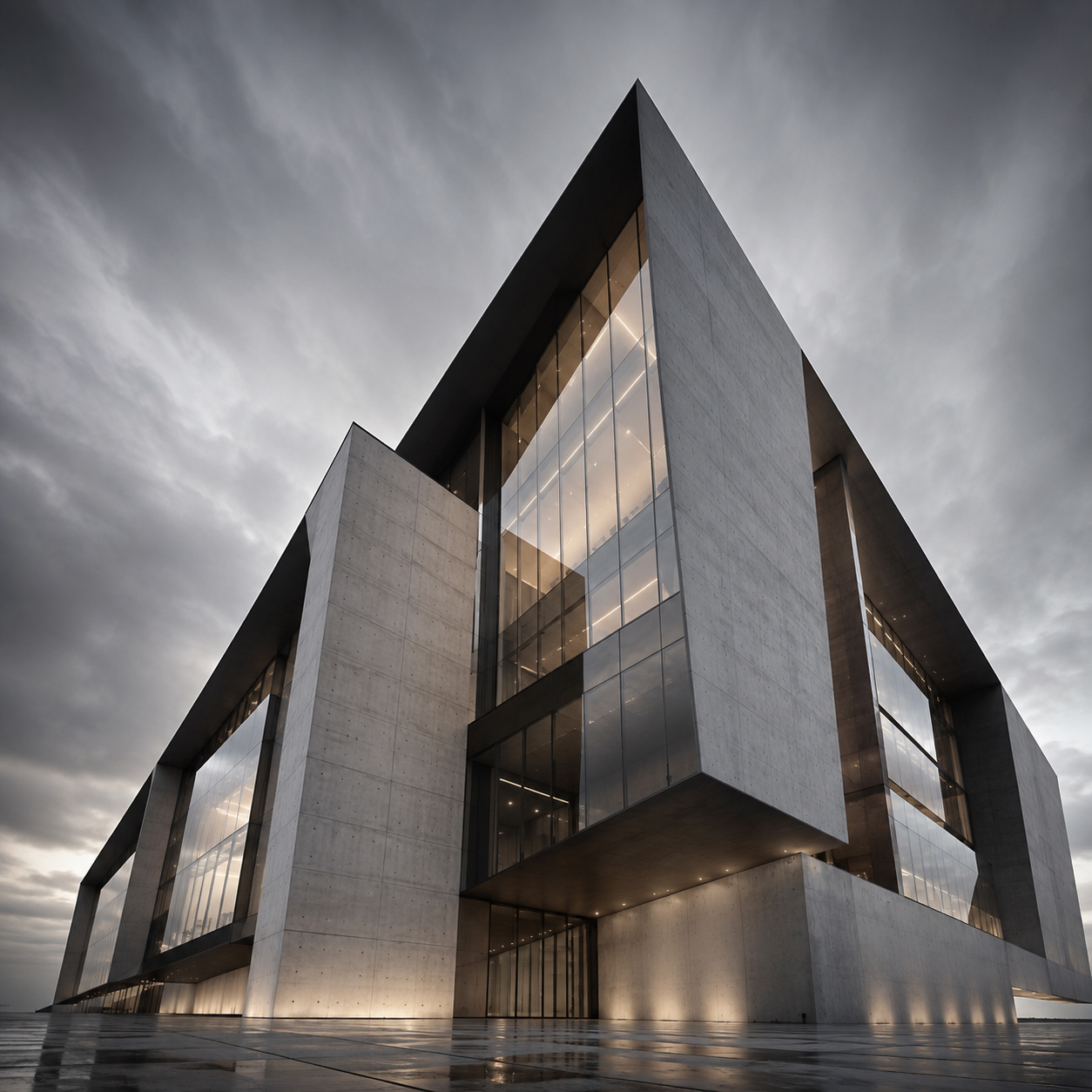
A visually confident architectural image can create immediate interest while still communicating too little about the proposal behind it.
When scale, access, spatial organization, context, or the relationship between major architectural elements remain unclear, the viewer may understand the visual ambition without gaining enough information to evaluate the project with confidence.
Strong presentation does not require every image to explain everything.
But the complete visual system should provide enough architectural evidence that persuasion is supported by understanding rather than replacing it.
WHAT NOT TO DO — Relying On A Hero Image Without Enough Supporting Architectural Evidence
A dramatic viewpoint can make a project memorable, but when essential spatial relationships remain unclear, the visualization may create impact without giving the viewer enough information to form a meaningful judgment.
BETTER
DIRECTION
Build conviction by connecting visual impact with architectural evidence.
Design Intent → Spatial Logic → Scale → Technical Reference → Visual Experience → Decision
A hero visualization can establish the emotional and architectural character of the project.
Supporting views can reveal relationships that a single perspective cannot explain.
Plans and sections can clarify circulation, scale, level changes, structure, and spatial organization when those questions matter to the discussion.
Material references can connect surface appearance to design intention rather than presenting finishes as decoration.
Contextual views can explain how the proposal relates to its site and surroundings.
And detail should be introduced according to the decision being made—not simply because more information is available.
The objective is not to overwhelm the viewer with technical content.
It is to create the right level of evidence for the right stage of understanding.
When visualization and architectural information support one another, the project becomes easier to discuss without losing the emotional strength that first attracted attention.
PROJECT
EVIDENCE
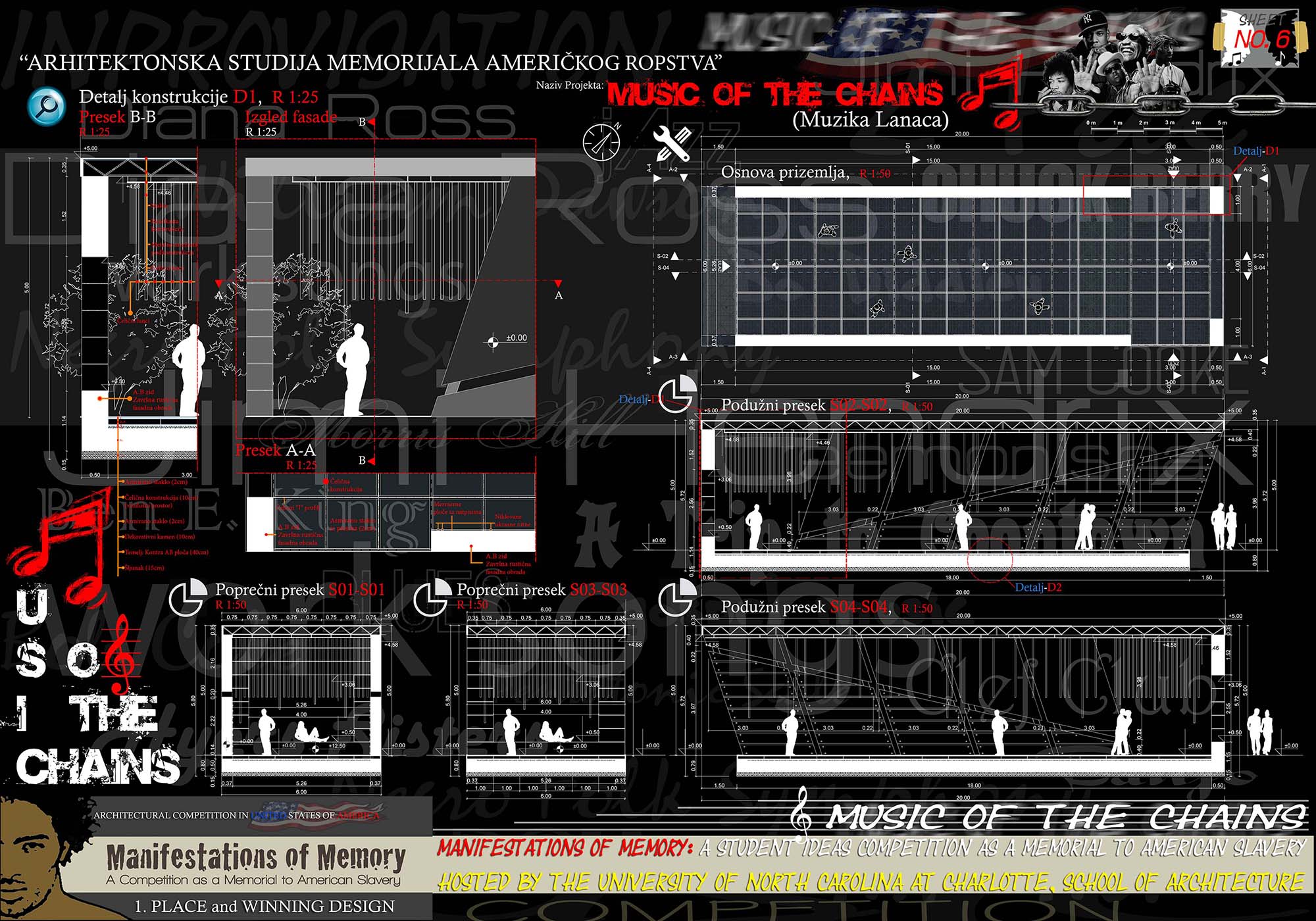
The Music of the Chains architectural presentation demonstrates a different role for visualization: not simply showing what a project might look like, but organizing multiple forms of architectural information into one coordinated communication system.
The presentation brings together plans, sections, elevations, construction detail, scale references, conceptual graphics, and architectural narrative rather than asking one image to carry the entire argument.
Each component answers a different question.
Plans clarify organization.
Sections reveal vertical relationships and spatial sequence.
Details communicate construction thinking.
Graphic elements reinforce the conceptual identity behind the proposal.
Together, these layers allow the project to move between idea, architecture, technical reasoning, and presentation without treating those dimensions as separate conversations.
The value comes from the relationship between them.
Visual conviction becomes stronger when the project can be understood from more than one point of view.
When Architectural Evidence Strengthens The Conviction Behind The Idea
WHY THIS EXAMPLE MATTERS
This presentation shows how architectural communication can combine conceptual expression with technical information without reducing either to a secondary role.
Plans, sections, details, dimensions, visual references, and graphic storytelling work together to explain different dimensions of the same project.
The result gives the viewer more than a memorable visual impression. It provides enough structure to understand how the concept develops into spatial and architectural logic.
That relationship matters because credibility is not created by technical information alone. It emerges when technical reasoning and visual communication reinforce the same project idea.
PROJECT EVIDENCE
When Concept, Plans, Sections, Details, Scale, And Visual Narrative Work As One System
A coordinated presentation of plans, sections, details, scale, and visual narrative gives an unbuilt proposal enough structure to be understood, discussed, and evaluated with greater confidence.
CONVICTION DOES NOT COME FROM MAKING AN IMAGE LOOK MORE CERTAIN.
IT COMES FROM GIVING THE IDEA ENOUGH VISUAL AND ARCHITECTURAL EVIDENCE TO DESERVE THAT CERTAINTY.
05 —
APPLICATION BEYOND THE IMAGE
WHY IT MATTERS
A strong architectural visualization should not become valuable only when it is viewed as a large, isolated hero image.
In practice, architectural ideas move through different forms of communication. They may need to be understood in a presentation, discussed alongside technical information, viewed at smaller scale, compared with alternatives, introduced to stakeholders, or used to explain a project to people encountering it for the first time.
That means visualization has another responsibility beyond creating impact:
it has to remain useful when the context around the image changes.
A composition that works beautifully at full size may lose its meaning when reduced. A highly cinematic crop may become difficult to reuse when more context is required. An image dominated by atmosphere may struggle when the viewer needs to understand scale, density, access, or the relationship between multiple parts of a development.
The strongest visualization therefore considers not only how the image looks, but what the image needs to continue communicating after the first impression is over.
COMMON FAILURE
The render works as a hero image, but becomes weaker everywhere else.
Some visualizations are composed so tightly around a single dramatic viewpoint that almost every important quality depends on ideal presentation conditions.
The image may require a large format to remain readable.
Critical architecture may sit too close to the crop.
Context may be sacrificed for visual drama.
The most important project relationships may disappear when the image is reduced.
And when the visualization needs to support a broader discussion, the viewer may be left with atmosphere rather than usable spatial information.
This does not make the image unsuccessful.
It means the image has been designed as an isolated moment rather than as part of a larger communication system.
When A Visualization Works Beautifully Only As A Hero Image
WHY THIS EXAMPLE MATTERS
A powerful composition can create immediate impact while depending heavily on scale, crop, and presentation conditions.
When the most important architectural relationships only become visible at large size—or when context has been sacrificed to create a more dramatic frame—the image may become difficult to use once the communication needs change.
Architectural visualization does not have to explain everything in every frame.
But its strongest signals should remain clear enough to survive beyond the ideal presentation moment.

WHAT NOT TO DO — Designing The Visualization For One Perfect Viewing Condition
A cinematic hero image can be highly effective, but when scale, context, and project relationships disappear outside the original composition, its usefulness becomes unnecessarily limited.
BETTER
DIRECTION
Design the visualization around the communication life of the project, not only the beauty of a single frame.
Primary Idea → Scale → Context → Readability → Adaptability → Application
The architectural subject should remain recognizable when the image is reduced.
Important project relationships should not depend entirely on edge-to-edge viewing.
Context should be preserved when it contributes to understanding scale, access, environment, or development density.
Composition should create a clear focal point while leaving enough visual structure for the image to remain useful in different presentation conditions.
And when one image cannot reasonably answer every question, the solution is not to force more information into the frame.
It is to create a coordinated family of views in which each visualization performs a specific communication role.
That means deciding which views should carry the project forward. A wide contextual image can explain scale and setting, while a closer frame reveals material character or experience. Planned deliberately, each visualization contributes something distinct instead of repeating the same message. The result is a coordinated visual system in which every image has a clear communication purpose.
The objective is not universal flexibility.
It is deliberate usefulness.
PROJECT
EVIDENCE
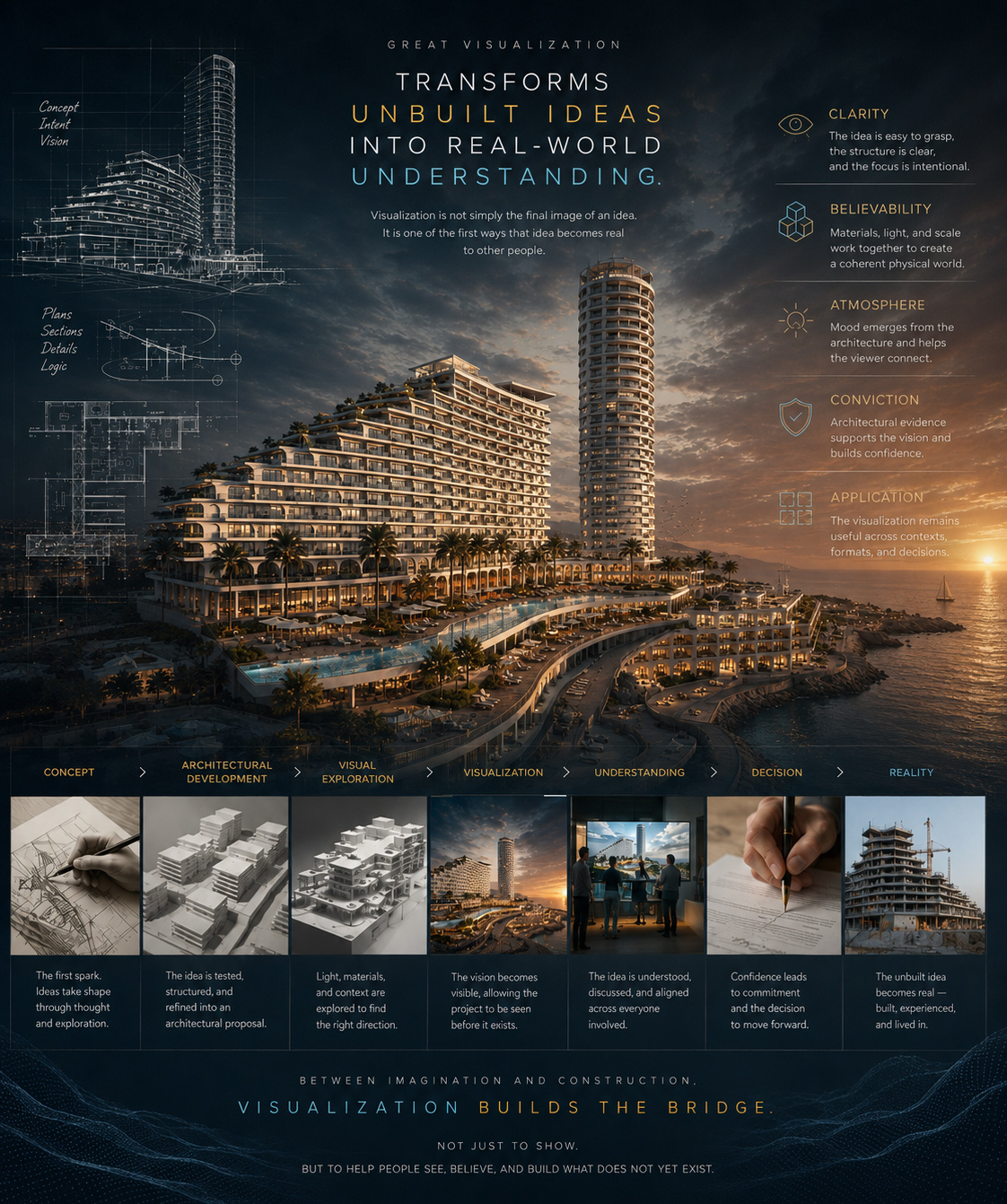
The large-scale coastal development visualization demonstrates why this becomes particularly important when architecture extends beyond a single building.
The image has to communicate multiple volumes, substantial differences in height, circulation areas, public and private zones, landscape, coastline, urban surroundings, and the relationship between the development and the sea within one readable composition, while preserving enough environmental context to explain how the individual parts belong to one whole, making the overall development easier to compare, discuss, and evaluate.
A tighter or more dramatic architectural crop might create a stronger isolated hero image, but it would sacrifice much of the information that makes the development understandable as a complete spatial system.
The elevated viewpoint instead provides hierarchy.
Major volumes remain identifiable.
The relationship between the tower, terraced building, lower development, pools, surrounding fabric, and coastline can be understood quickly.
At the same time, the architecture still retains enough visual character to function as more than technical documentation.
The visualization succeeds because visual impact and informational usefulness are allowed to coexist.
When Visualization Communicates The Project Beyond A Single Architectural Object
WHY THIS EXAMPLE MATTERS
Large-scale developments require the viewer to understand relationships that cannot be communicated through façade detail or atmosphere alone.
This visualization makes the overall development legible by revealing the hierarchy between major buildings, surrounding urban fabric, landscape, circulation, amenities, and coastline.
The elevated perspective gives the viewer enough distance to understand the complete system while maintaining sufficient architectural detail to preserve character and visual interest.
The result demonstrates an important principle: sometimes the most valuable visualization is not the closest or most dramatic image, but the one that gives the project exactly the context required to be understood.

PROJECT EVIDENCE
Large-Scale Visualization Built Around Context, Hierarchy, And Project Readability
A coordinated view of architecture, landscape, urban context, circulation, and scale allows a complex development to remain visually compelling while communicating relationships that would disappear in a tighter hero composition.
THE VALUE OF A VISUALIZATION DOES NOT END WITH THE IMAGE THAT ATTRACTS ATTENTION.
IT CONTINUES THROUGH EVERY CONTEXT IN WHICH THE PROJECT STILL NEEDS TO BE UNDERSTOOD.
FROM VISUALIZATION TO SHARED BELIEF
Great Visualization Makes The Unbuilt Easier To Understand, Trust, And Act On
The strongest architectural visualization does more than make a future project visible. It creates a shared point of understanding between the idea, the people developing it, and the people who still need to believe in what does not yet physically exist.
Architecture begins long before construction. It exists first through drawings, models, conversations, decisions, technical information, and imagination. Visualization connects those layers by translating spatial intention into something that can be experienced more directly.
Across the five dimensions explored in this article, the same principle keeps returning: clarity, believability, atmosphere, conviction, and application are not separate visualization problems. They are interconnected parts of how an unbuilt project becomes understandable to another person.
A compelling image can attract attention. Photorealism can increase credibility. Atmosphere can create emotion. Technical evidence can strengthen confidence. Context can explain relationships that a dramatic close-up cannot.
But the real strength emerges when those responsibilities work together.
When visualization is built around that larger purpose, it no longer functions only as the final image of a design process. It becomes one of the first places where architecture can already be understood, questioned, discussed, trusted, and imagined as part of the real world.
THE FIVE DIMENSIONS OF CONVINCING ARCHITECTURAL VISUALIZATION
Clarity makes the idea understandable. Believability makes the visual world physically coherent. Atmosphere gives the architecture emotional character. Conviction connects visual impact with enough architectural evidence to support judgment. Application ensures that the visualization remains useful beyond one perfect image.
Considered together, these five dimensions transform rendering from a representation technique into a complete architectural communication system capable of carrying an idea from imagination toward decision.
VISUALIZATION IS NOT SIMPLY THE FINAL IMAGE OF AN IDEA.
IT IS ONE OF THE FIRST WAYS THAT IDEA BECOMES REAL TO OTHER PEOPLE.
FROM VISUAL IMPACT TO PRACTICAL DECISION-MAKING
Key Takeaways
A practical framework for evaluating whether architectural visualization is merely impressive—or whether it is actually helping an unbuilt project become clearer, more credible, more emotionally meaningful, and easier to respond to.
The five principles explored throughout this article point toward one broader idea: strong architectural visualization is created when visual quality, spatial communication, physical coherence, emotional tone, architectural evidence, and practical purpose are treated as parts of the same system.
These takeaways can be used when reviewing a single render, planning a complete visualization set, presenting an architectural proposal, or deciding what kind of image a particular stage of the project actually requires.
01 —
CLARITY BEFORE VISUAL COMPLEXITY
A visualization should first make the architectural idea easier to understand.
More geometry, detail, objects, or information do not automatically create stronger communication. The viewer should know what matters, where to look, and which spatial relationships deserve attention before visual complexity begins competing with the project itself.
02 —
COHERENCE BEFORE PERFECTION
Believability does not depend on making every surface flawless.
Light, materials, scale, reflections, texture, contact, and environmental behavior should feel as though they belong to the same physical world. A coherent scene is often more convincing than a technically perfect image in which individual effects do not agree with one another under changing viewing conditions.
03 —
ATMOSPHERE BEFORE SPECTACLE
Mood should emerge from the architecture rather than sit on top of it.
Weather, light, camera position, landscape, color, and interior illumination can create powerful emotion, but atmosphere becomes most valuable when it helps explain how the architecture may actually feel to approach, occupy, and experience within its intended spatial and environmental context, across changing conditions and viewpoints.
04 —
EVIDENCE BEFORE CONVICTION
A powerful image can attract attention, but confidence grows when visual ambition is supported by architectural reasoning.
Plans, sections, context, scale, supporting views, details, and spatial relationships can provide the evidence required to move the conversation from “this looks compelling” to “I understand enough of this project to evaluate it seriously.”
05 —
APPLICATION BEFORE ISOLATION
A visualization should be created with an understanding of where and how it needs to communicate.
Hero images, contextual views, technical presentations, wide development perspectives, interior scenes, and supporting imagery perform different roles. The strongest visualization system does not ask one perfect frame to solve every communication problem. Instead, each image should contribute a distinct perspective while supporting one architectural narrative across contexts.
THE STRONGEST VISUALIZATION IS NOT THE ONE THAT LOOKS THE MOST REAL.
IT IS THE ONE THAT MAKES AN UNBUILT IDEA EASIEST TO UNDERSTAND, BELIEVE IN, AND ACT ON.