


FROM APPROVAL TO REAL-WORLD CONSEQUENCE
A Project Can Be Right On Paper And Still Lose Value Before It Reaches Reality.
The distance between a strong decision and a strong delivered result is filled with translation, interpretation, responsibility, constraints, revisions, and dozens of smaller choices that can either protect the original objective—or quietly redefine it.
The distance between a strong decision and a strong delivered result is filled with translation, interpretation, responsibility, constraints, and smaller choices that can protect the original objective—or quietly redefine it.
A project may begin with clear objectives, sound strategy, credible technical reasoning, an approved budget, and experienced people—yet still arrive at a weaker result.
That is because approval does not remove complexity. It changes its form. The original reasoning must survive documents, suppliers, revisions, technical limitations, physical conditions, and people who were not present when the decision was made.
Every meaningful decision therefore needs more than approval. It needs enough context to preserve what the project is trying to achieve, which conditions matter most, where compromise is acceptable, and what must remain protected as implementation changes.
Without that context, reasonable local decisions can gradually weaken the whole. A supplier substitution, technical simplification, production adjustment, or previously rejected option may each appear sensible in isolation.
The problem begins when a sequence of locally rational choices moves the project away from the objective they were meant to protect.
Professional continuity does not prevent change. Real projects change because materials, platforms, suppliers, budgets, evidence, and implementation conditions change.
The professional question is whether the project can still answer:
What changed? Why? What does it affect? What must remain protected? Who owns the consequence? And does the new condition still support the original objective?
When those answers remain visible, change can be controlled.
When they disappear, change becomes drift.
A PROJECT RARELY LOSES VALUE IN ONE DRAMATIC FAILURE.
IT LOSES VALUE WHEN SMALL, INDIVIDUALLY REASONABLE CHANGES ACCUMULATE WITHOUT A SHARED UNDERSTANDING OF WHAT THE ORIGINAL DECISION WAS SUPPOSED TO PROTECT.
FIVE PRESSURE POINTS BETWEEN DECISION AND DELIVERY
What Must Remain Intact As A Project Moves Beyond The People Who First Defined It.
Reasoning. Translation. Interpretation. Implementation. Continuity.
A strong project cannot depend on one person remembering everything, one document explaining everything, or one approval resolving everything.
Once work moves through teams and systems, the original direction becomes distributed across commercial, design, technical, supplier, production, and implementation perspectives.
Each perspective may be valid.
The risk begins when those perspectives stop being connected to one shared understanding of what the project must protect.
The journey from decision to delivery is therefore a chain of professional translations. Every stage inherits information, adds judgment, and passes the project forward.
Five areas become critical:
Decision Integrity preserves what was approved, why it was approved, and which conditions should not be casually compromised.
Technical Translation converts intention into usable requirements—dimensions, materials, tolerances, standards, acceptance criteria, responsibilities, and implementation rules.
Handoff & Interpretation protects meaning as responsibility changes. A handoff succeeds when the receiving party can act without reconstructing the project through assumption.
Implementation Reality introduces constraints that no approval can fully predict. The task is to distinguish adaptation that protects the objective from convenience that quietly changes it.
Continuity & Traceability preserve decisions, deviations, rejected alternatives, technical limitations, and implementation lessons so that project knowledge remains usable later.
These areas are inseparable.
Weak reasoning creates ambiguity in technical translation. Ambiguous translation increases interpretation during handoff. Interpretation creates uncontrolled variation in implementation. Poor traceability then makes the origin of that variation difficult to understand.
The reverse is equally true: visible reasoning strengthens specifications, clearer specifications improve handoffs, clear responsibility supports better implementation decisions, and documented change gives future work a stronger starting point.
This creates the framework for the five sections that follow:
01 — Decision Integrity — Preserve The Reasoning Before Responsibility Moves.
02 — Technical Translation — Turn Intention Into Conditions Another Person Can Use.
03 — Handoff & Interpretation — Move Responsibility Without Leaving Meaning Behind.
04 — Implementation Reality — Adapt Without Quietly Redefining The Objective.
05 — Continuity & Traceability — Preserve What The Project Has Already Learned.
Together, they lead to one larger question:
Can a project move through people, documents, systems, vendors, revisions, constraints, and implementation without gradually becoming a different answer to a different problem?
A STRONG DELIVERY SYSTEM DOES NOT FREEZE A PROJECT IN PLACE.
IT GIVES THE PROJECT ENOUGH SHARED REASONING, TECHNICAL CLARITY, RESPONSIBILITY, AND TRACEABILITY TO CHANGE WITHOUT LOSING ITS PURPOSE.
EDITORIAL MODEL · DECISION INTEGRITY · TECHNICAL TRANSLATION · PROJECT CONTINUITY
One Decision. Five Places Where Its Meaning Can Either Survive Or Begin To Drift.
WHY THIS MODEL MATTERS
A decision rarely moves directly from approval into final delivery. It passes through different forms of professional responsibility—each of which introduces new information, new constraints, and new opportunities for interpretation.
This editorial model visualizes that movement as one connected project rather than five isolated tasks. The objective is to show how reasoning becomes specification, specification becomes shared responsibility, responsibility encounters real implementation, and implementation produces knowledge that should remain available for whatever happens next.
The important detail is continuity. Every stage should inherit enough intelligence from the previous one to make its own decisions without unintentionally changing the objective.

PROJECT OVERVIEW — One Project Traced Across Decision, Technical Translation, Handoff, Implementation, And Continuity—Showing How Meaning, Responsibility, And Technical Logic Must Remain Connected As The Work Moves Toward Real Delivery.
01 —
A GOOD DECISION IS NOT YET A DELIVERED RESULT
WHY IT MATTERS
A project decision creates direction, but it does not automatically protect the result that direction was intended to produce.
Between approval and delivery, that decision must pass through people, documents, technical interpretation, suppliers, revisions, production conditions, and implementation choices. Every transition creates another point where meaning can remain intact—or begin to change.
This is why professional project control cannot stop at “approved.”
Approval confirms what should move forward, but it does not always preserve why that direction was selected, which alternatives were rejected, what constraints shaped it, and what must remain protected if circumstances change.
That distinction matters because implementation rarely happens under exactly the conditions in which the decision was made. Materials become unavailable. Suppliers propose substitutes. Platforms impose limitations. Production teams identify faster routes. Stakeholders request revisions. Physical conditions introduce new constraints.
None of those situations automatically invalidate the original direction.
They create a more important question:
Can the project adapt without losing the reasoning that made the original decision valuable?
That requires enough context for another qualified person to understand what the decision protects, where flexibility exists, which boundaries should remain intact, and what consequences must be reviewed before change is accepted.
When that context remains accessible, adaptation can be intelligent.
When it disappears, implementation begins operating on fragments.
A strong decision must remain understandable after the person who made it is no longer the only person carrying it forward.
COMMON FAILURE
When Approval Records The Answer But Not The Reason Behind It
One of the most common weaknesses in professional project work is assuming that an approved outcome is self-explanatory.
A file may say Approved. A specification may identify the selected material. A drawing may define the required dimension. A design may show the accepted composition. Yet none of those elements necessarily explain which parts of the decision are essential, which are negotiable, and why that distinction matters.
That becomes critical later.
A supplier may propose a comparable material. A developer may simplify an interaction. A contractor may adjust a detail for constructability. A production team may change dimensions to match available tooling.
From their local perspective, each modification may be entirely reasonable.
The problem is that local technical logic does not always equal project logic.
A material may have been selected for more than strength. An interaction may protect orientation or consistency, not merely complete a task. A dimensional decision may be tied to assembly tolerances, packaging, transport, ergonomics, or downstream production.
When those relationships are not preserved, the project becomes vulnerable to technically acceptable decisions that are strategically wrong.
Value often begins to erode not through negligence or incompetence, but because each person is solving only the part of the problem they can see.
The project weakens when the approved answer survives, but the reason behind the answer does not.
WHEN A PROJECT RECEIVES THE DECISION BUT NOT THE DECISION LOGIC
Consider a project in which a component has been approved after several alternatives were evaluated.
The supplier receives the correct geometry, material reference, and finish, so the handoff appears complete. During production preparation, however, a more available material and a small dimensional adjustment are proposed to simplify tooling.
Both changes appear reasonable. Both remain within basic functional requirements.
The problem is that the approved material was selected not only for availability or strength, but for surface performance, long-term consistency, assembly behavior, and compatibility with another part of the system. The original dimension was also connected to a downstream fit condition that is not visible in the isolated drawing.
Without that reasoning, the supplier cannot reliably distinguish what may change, what must remain fixed, and which condition requires renewed approval.
The result may still be technically well manufactured—yet no longer solve the same project problem.
That is the core of decision integrity: preserving enough reasoning for change to remain informed rather than accidental.
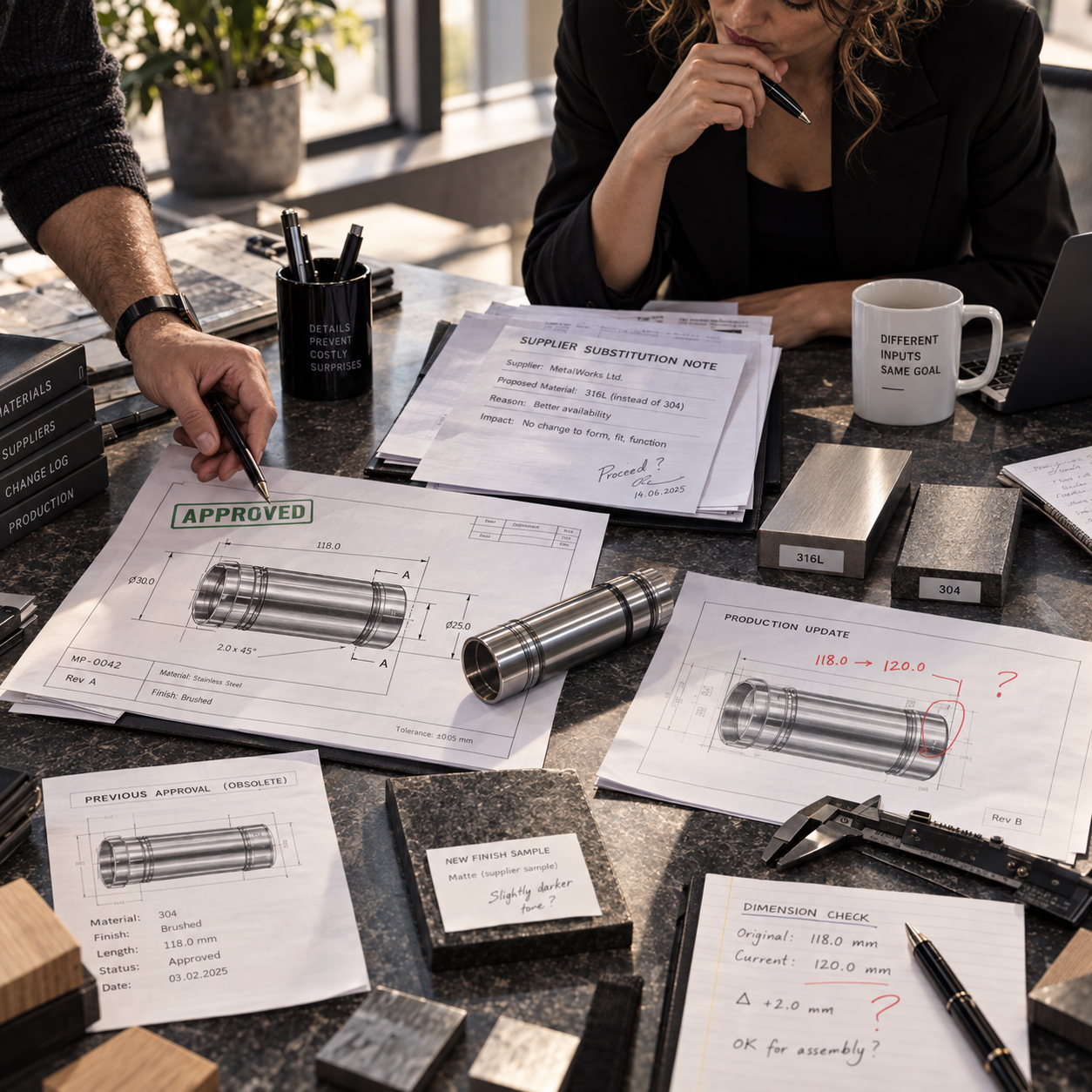
WHAT NOT TO DO — Treat An Approved Outcome As If It Explains Its Own Logic
When the project records only the selected answer, every later participant is forced to reconstruct the missing context through assumption. The more people, vendors, revisions, and implementation stages the decision passes through, the greater the possibility that a reasonable local adjustment will unintentionally weaken the original objective.
BETTER
DIRECTION
PRESERVE THE REASONING THAT MAKES THE DECISION USEFUL
A professional decision record should not become an essay.
It should preserve the minimum critical intelligence required for another person to carry the decision forward responsibly.
Begin with the decision itself:
What has been approved?
Then preserve the logic around it:
Why was this option selected?
What project objective does it protect?
Which constraints influenced the choice?
Which alternatives were considered?
Why were those alternatives rejected?
Which characteristics are essential?
Where is adaptation permitted?
Which change would require renewed review or approval?
A useful decision record therefore connects:
Decision → Reason → Protected Condition → Permitted Flexibility → Approval Trigger
This creates an important distinction between the form of the current solution and the purpose the solution is required to protect.
When real conditions change, the team can then adapt the form without accidentally abandoning the purpose.
That preserved reasoning also makes later review faster, clearer, and more defensible when new constraints, suppliers, or implementation conditions appear.
It also helps future teams distinguish adaptation from unintended departure.
The objective is not to eliminate professional judgment.
It is to give professional judgment enough context to remain aligned through every decision that follows.
A documented decision should make the next decision stronger—not force the next person to rediscover the project from the beginning.
DECISION
CONTINUITY
MAKE THE PROJECT LEGIBLE BEYOND THE PERSON WHO FIRST APPROVED IT
Decision integrity becomes especially important when responsibility changes.
A project may move from strategist to designer, designer to engineer, engineer to supplier, supplier to production, production to quality control, and eventually to another team responsible for future updates or maintenance.
Each stage sees a different part of the same project.
That makes the decision record a continuity tool.
It should allow another qualified person to identify:
Current approved direction
What is valid now?
Decision rationale
Why does this direction exist?
Critical dependencies
What else relies on it?
Known constraints
What conditions already shaped the solution?
Rejected alternatives
What has already been considered and why was it not selected?
Change authority
Who can approve a deviation?
Revalidation condition
What type of change requires the decision to be reviewed again?
This creates traceability without turning the project into bureaucracy.
The purpose is not to document every conversation.
The purpose is to preserve the decisions whose meaning would be expensive to lose.
A strong system therefore asks a practical question:
If the original decision-maker disappeared from the project tomorrow, would the next qualified person understand enough to continue responsibly?
If the answer is no, the project may have an approval—but it does not yet have decision continuity.
WHEN THE DECISION CARRIES ENOUGH CONTEXT TO SURVIVE THE NEXT PERSON
WHY THIS EXAMPLE MATTERS
Now consider the same project with one important difference.
The approved component is supported by a concise decision record explaining the performance objective, material rationale, critical dimensional relationship, accepted tolerance, rejected alternative, and conditions requiring renewed approval.
The supplier encounters the same production constraint and proposes the same substitution.
This time, however, the team can evaluate the change against the reasoning behind the specification rather than choosing between rigid compliance and convenient substitution.
If the alternative preserves the required performance, finish, compatibility, and long-term behavior, it may be acceptable. If it does not, the project knows exactly why.
If the dimensional change affects an identified assembly dependency, it is escalated before production rather than discovered after implementation.
The project has not become inflexible.
It has become intelligently adaptable.
That is the difference between documentation that merely stores information and documentation that supports professional judgment.

EDITORIAL MODEL
One Approved Decision — Preserved Across Reasoning, Technical Review, Change, And Implementation.
The model demonstrates how an approved direction becomes more resilient when the project records why the decision exists, which conditions it protects, where flexibility remains possible, and what type of deviation requires renewed professional review.

DECISION INTEGRITY
A Strong Decision Becomes More Valuable When Another Qualified Person Can Understand What Must Remain True.
The strength of a decision is not measured only at the moment it is approved.
It is measured again when somebody else must interpret it.
Again when a constraint appears.
Again when an alternative is proposed.
Again when production begins.
Again when the project is revised months later.
A decision that depends entirely on the memory of the person who originally made it is fragile.
A decision whose reasoning is clear enough to support responsible adaptation becomes part of the project’s infrastructure.
THE STRONGEST DECISIONS ARE NOT ONLY APPROVED.
THEY ARE MADE LEGIBLE TO THE PEOPLE WHO MUST CARRY THEM FORWARD.
02 —
TECHNICAL TRANSLATION BEFORE HANDOFF
WHY IT MATTERS
A project does not move from decision to execution through intention alone.
It moves through translation.
An approved direction can begin losing value as soon as it reaches people who were not part of the original decision.
Strategic intent may be clear: the component must resist corrosion, maintain dimensional integrity, support long-term performance, and fit existing production constraints.
But unless that intent becomes technical requirements, measurable tolerances, material conditions, review logic, and clear change boundaries, the project remains vulnerable to interpretation.
This is where drift often begins—not because the original thinking was weak, but because the next person inherits the answer without the logic that made it correct.
Strong Consulting & Technical Support therefore continues beyond approval. It translates direction into information that suppliers, engineers, contractors, manufacturers, installers, and reviewers can act on responsibly.
Good technical translation preserves performance intent, critical constraints, acceptable flexibility, and the conditions that require renewed review.
That is the difference between documentation that merely exists and documentation that actively protects the project.
A decision creates operational value when another qualified person can carry it forward without guessing what mattered most.
COMMON FAILURE
The Decision Is Approved, But The Project Is Not Yet Technically Aligned
Many teams assume approval means the difficult part is over.
In reality, approval often marks the point where technical responsibility begins.
A direction may be accepted while its practical meaning remains underdefined: material references stay generic, critical tolerances are not distinguished from preferred ones, drawings show dimensions without explaining which protect performance, and alternatives appear reasonable without clear guidance on what must remain unchanged.
The project can still move forward.
Quotes can be requested. Samples reviewed. Production started.
But progress may now depend on private interpretation rather than shared technical clarity.
That is how serious work becomes fragile—not because people are careless, but because the project no longer communicates its own reasoning strongly enough.
Weak translation forces each new participant to reconstruct intent independently, increasing inconsistent judgment and the risk that later changes erode the original decision unnoticed.
When technical meaning is not made explicit, progress continues—but precision becomes negotiable.
When An Approved Direction Moves Forward Without A Shared Technical Definition
WHY THIS EXAMPLE MATTERS
This example shows what happens when a project contains the right information, but that information does not operate as one coordinated decision system.
The component, drawing, production note, supplier substitution, and material reference may all exist.
Yet the project can still become unstable when the relationship between those elements is unclear.
One document confirms approval. Another introduces change. A later mark-up suggests adjustment. What is missing is the reasoning that explains why the original conditions mattered, which requirements must remain protected, and whether the proposed change stays within acceptable boundaries.
That is the difference between having information and having continuity.
Technical failure often begins long before manufacturing, installation, or delivery.
It begins when the project stops carrying forward the meaning of the original decision.
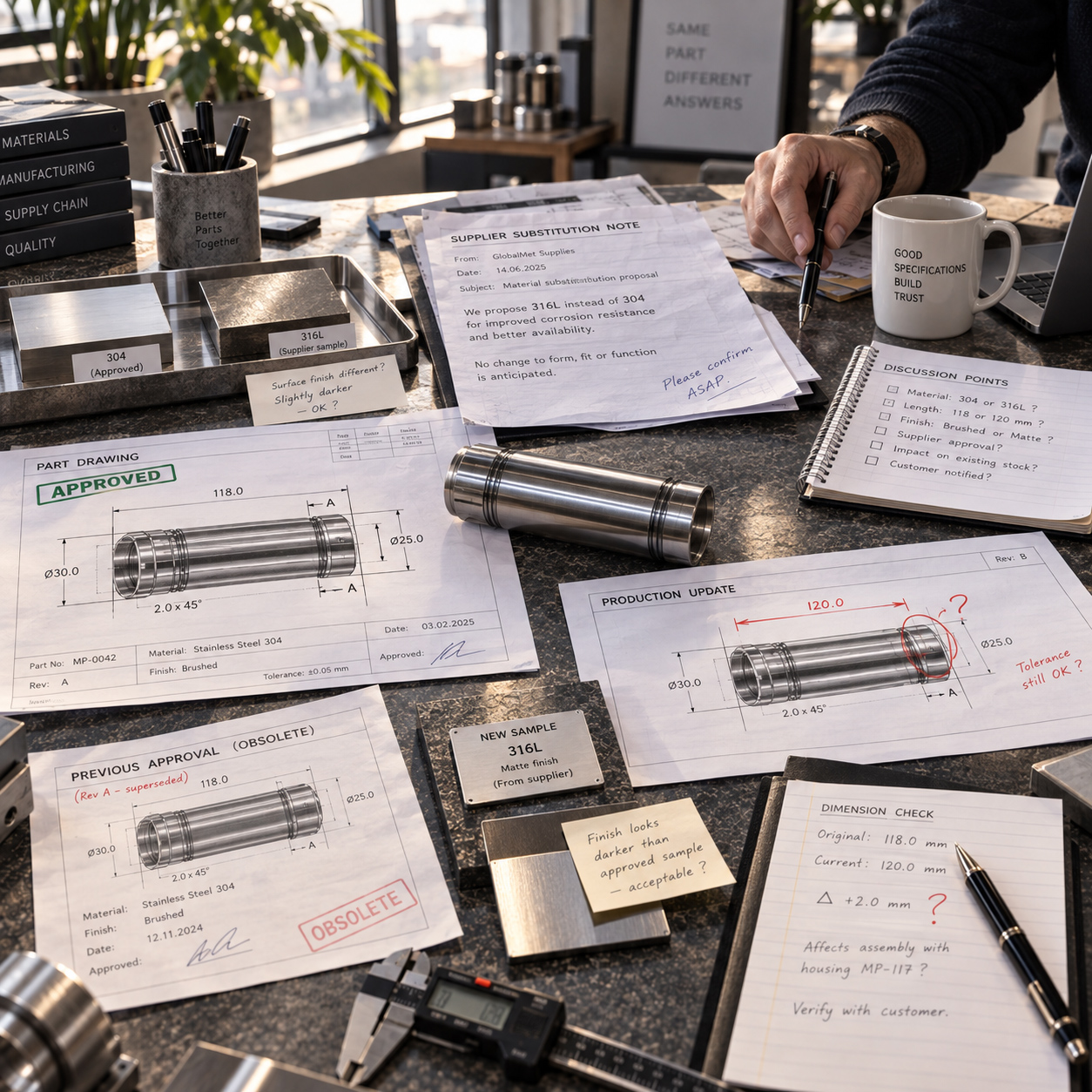
WHAT NOT TO DO — Let Technical Documents Accumulate Without Turning Them Into One Governed Technical Logic
A project becomes difficult to protect when drawings, notes, substitutions, and revisions continue to multiply without one clear structure explaining what is fixed, what is flexible, and what requires renewed approval.
BETTER
DIRECTION
TRANSLATE THE DECISION BEFORE OTHERS MUST INTERPRET IT WITH FULL CONTEXT
A strong technical package should not merely describe the selected answer.
It should explain the operating logic that keeps the answer valid.
That means the project should clearly identify:
- the approved decision
- the reason it was approved
- the performance requirement it protects
- the material and specification it depends on
- the tolerances that are permitted
- the alternatives that are not acceptable
- the change conditions that trigger technical review
- the dependencies that connect this part of the project to later work
When those relationships are visible, the project becomes easier to review, easier to adapt responsibly, and harder to weaken accidentally.
A strong translation does not remove flexibility.
It defines where flexibility can exist without destroying intent.
That is what allows later participants to respond professionally instead of reactively.
TECHNICAL
CONTROL
In this article, the strongest evidence is not the presence of more paperwork.
It is the presence of connected documentation.
The approved direction remains legible because the component, the drawing, the material reference, the tolerance note, the review result, and the final revision all continue to speak the same technical language.
That continuity allows a supplier proposal to be reviewed against defined requirements.
It allows a dimensional adjustment to be judged against performance rather than preference.
It allows change to be absorbed without losing the reason the project was approved in the first place.
This gives every later participant a reliable reference for interpretation, verification, coordination, and controlled implementation.
The project therefore becomes more than documented; it becomes structured, traceable, understandable, and professionally actionable.
It becomes technically interpretable by others without surrendering its original logic.
When One Approved Decision Becomes A Controlled Technical Reference For Everyone Who Follows
WHY THIS EXAMPLE MATTERS
This second example shows the stronger condition.
The decision is no longer represented by one drawing. It becomes a controlled technical reference carried consistently through the decision record, specification, supplier review, implementation note, approved revision, and continuity archive.
That consistency matters because the project is no longer relying on memory.
It is relying on structure.
Each participant can understand what the component is, which standards govern it, what may change, what must remain protected, and which outcome has been formally approved.
The project therefore becomes easier to carry across vendors, revisions, responsibilities, and time.
That is the purpose of technical translation in Consulting & Technical Support:
not to create more documentation, but to make the project durable under movement.
When responsibility changes hands, the reasoning should remain with the project.
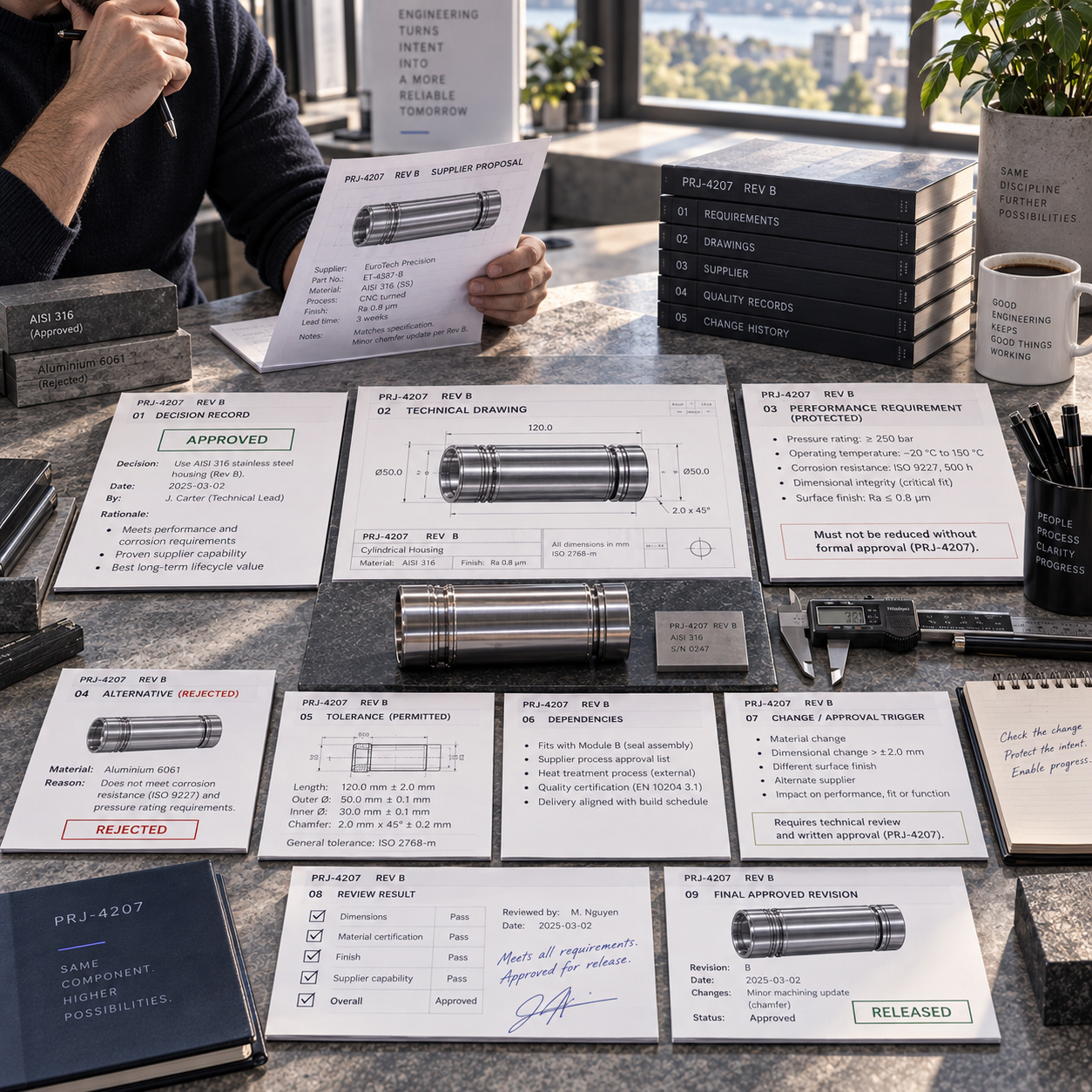
CONTROLLED TECHNICAL MODEL
One Approved Direction — Translated Into Technical Requirements Another Qualified Person Can Review, Adapt, And Implement Without Losing The Original Logic.
The model shows how technical translation becomes reliable when the approved decision, performance requirements, material conditions, permitted tolerances, dependencies, review triggers, and final revision status remain connected. The objective is not more documentation—it is a technical reference clear enough to support responsible change without forcing the next person to reconstruct the project’s intent.
TECHNICAL CLARITY IS NOT THE AMOUNT OF INFORMATION A PROJECT CONTAINS.
IT IS THE ABILITY OF ANOTHER QUALIFIED PERSON TO UNDERSTAND WHAT MUST REMAIN TRUE, WHAT MAY CHANGE, AND WHEN A CHANGE MUST RETURN FOR REVIEW.
03 —
HANDOFF & CONTEXT
WHY IT MATTERS
A project is not protected simply because the right information exists.
At some point, that information must pass from the people who created or approved it to the people who must act on it.
That transition is a handoff—and it is one of the most vulnerable moments in delivery because responsibility can move faster than understanding.
A drawing can be transferred. A specification uploaded. A revision issued. A supplier briefed.
But none of those actions proves that the receiving side understands what is approved, what remains open, which conditions are protected, where flexibility exists, and who owns the next decision.
Technical translation makes a decision usable.
A handoff must ensure that usable information survives a change of responsibility.
The receiving team rarely has the same project history as the team handing it over. They may not know which alternatives were rejected, why one requirement is critical, which dependency a note protects, or where a legitimate new implementation issue begins.
That is why a strong handoff is not a file-transfer event.
It is a transfer of project state.
The next person needs to know:
What is approved?
What is provisional?
What remains open?
What has already been rejected?
Which dependencies must be protected?
Who owns the next action?
What type of change must return for review?
Without that clarity, interpretation fills the gaps.
Professional judgment is necessary. The problem begins when judgment is used to reconstruct information the project should already have made explicit.
A handoff becomes reliable when the receiving team can continue the work without rediscovering the project’s current truth.
COMMON FAILURE
Responsibility Moves, But Context Does Not
Weak handoffs can look perfectly professional from the outside.
The folder is organized. The latest drawing has been sent. The supplier has received the package. The meeting has happened. The email says “Please proceed.”
Yet the receiving side may still lack the context needed to act safely.
One person believes a condition is final. Another believes it remains open. A supplier assumes an alternative is acceptable because the original rejection logic was not transferred. A production team has the latest revision but not the later note that changes how it should be interpreted.
The issue is no longer whether information exists.
It is whether everyone is working from the same project state.
This is what makes handoff failures difficult to detect. Work can continue, nobody appears blocked, and every participant may believe they are acting reasonably.
But the project begins operating through different versions of the truth.
One team carries historical context. Another carries the latest drawing. A supplier carries a production assumption. A stakeholder carries an earlier approval. A project manager carries the schedule.
Each fragment may be valid.
The project becomes vulnerable because those fragments no longer form one shared understanding.
Once ambiguity enters execution, later correction becomes more expensive because the project must first determine where interpretation diverged before it can decide what should happen next.
A weak handoff does not necessarily lose information. It loses the relationship between information, responsibility, and current project state.
When A Handoff Transfers Files Without Transferring The Current Decision State
WHY THIS EXAMPLE MATTERS
This example shows a handoff that appears complete but has not been converted into one explicit project state.
The drawings, specification, supplier correspondence, revisions, and open questions all exist.
What is missing is a clear definition of which revision governs the next action, what remains unresolved, which options are closed, what has already been approved, which dependencies must be protected, and who now owns the outstanding decision.
The receiving side therefore has to reconstruct the project history instead of continuing from a clearly defined present state.
A technically competent person may still make a reasonable judgment—but if that judgment begins from an incomplete understanding of the project, the result can drift from the intended direction.
The danger is not an empty handoff.
It is a handoff that looks complete while leaving its most important relationships implicit.

WHAT NOT TO DO — Treat The Handoff As Complete Because The Files Have Been Delivered
A transfer becomes fragile when the receiving team must infer revision status, unresolved issues, decision ownership, dependencies, and approval boundaries from documents that were never structured to communicate one shared project state.
BETTER
DIRECTION
TRANSFER THE PROJECT STATE — NOT ONLY THE PROJECT FILES
A professional handoff should make the current condition of the project immediately legible.
The receiving team should not have to reconstruct the past in order to understand the present.
That means the handoff must identify:
Current Approved State
What is formally valid now?
Open Decisions
What still requires judgment or confirmation?
Closed Decisions
What has already been resolved and should not be reopened without new evidence?
Critical Dependencies
Which later activities rely on these conditions remaining intact?
Known Deviations
What has changed from the earlier approved direction?
Responsibility
Who owns each remaining action?
Escalation Condition
What type of issue requires renewed review rather than local interpretation?
Next Action
What exactly should happen after the handoff?
The objective is not to make every participant read the entire project history.
It is to give them enough of the right history to understand the state they are inheriting.
A strong handoff therefore compresses complexity without erasing meaning.
It separates what the receiving team needs to know now from what simply happens to exist in the archive.
That is how continuity becomes operational across every stage that follows.
HANDOFF
CONTROL
MAKE OWNERSHIP, OPEN QUESTIONS, AND APPROVAL STATUS IMPOSSIBLE TO CONFUSE
Professional handoff control is not created by producing more documentation.
It is created by removing ambiguity around responsibility.
A receiving team should be able to identify, quickly and confidently:
what they are authorized to execute,
what they are expected to review,
what they are not authorized to change independently,
and
where unresolved questions must go next.
This becomes especially important when several disciplines overlap.
A supplier may own manufacturability.
An engineer may own technical compliance.
A designer may own an appearance-critical condition.
A project lead may own the final decision.
Quality control may own verification.
Those responsibilities can coexist without conflict only when the boundaries between them remain visible.
A handoff should therefore connect:
Information → Status → Owner → Required Action → Approval Route
When one of those relationships is missing, the next person must invent it.
When all five are visible, professional judgment can operate within a controlled framework.
Clear ownership also prevents unresolved issues from disappearing between teams.
The purpose of handoff control is not to reduce responsibility. It is to make responsibility precise.
When The Receiving Team Can See What Is Decided, What Is Open, And What They Now Own
WHY THIS EXAMPLE MATTERS
The stronger condition uses the same project, technical requirements, and professional participants.
The difference is not the amount of information.
It is the state of that information when responsibility changes hands.
The receiving team gets one controlled handoff package that identifies the governing revision, approved conditions, unresolved items, known deviations, dependencies, responsible parties, approval boundaries, and immediate next actions.
Earlier documents remain accessible, but they no longer compete with the current state.
A supplier knows which requirement governs production. An engineer knows which technical question remains open. A project lead knows where approval is still required. A later participant can see which deviation was intentionally accepted and why.
Nobody has to treat silence as approval, guess whether an old note still applies, or rely on a private conversation they never heard.
The handoff therefore becomes more than administrative continuity.
It becomes a professional control point that allows the project to move between people, organizations, and stages without rebuilding the decision environment from fragments.
Responsibility can change hands without meaning becoming weaker each time it moves.

CONTROLLED HANDOFF MODEL
One Project State — Transferred With Its Decisions, Open Questions, Responsibilities, And Approval Boundaries Intact.
The model demonstrates how professional continuity becomes stronger when a handoff communicates not only documentation, but also current status, unresolved conditions, decision ownership, known deviations, dependencies, and the route for whatever requires renewed judgment.
The objective is not to prevent the receiving team from thinking independently.
It is to ensure that their judgment begins from the project’s actual current state rather than from an incomplete reconstruction of what may have happened before they became responsible for it.
HANDOFF INTEGRITY
A Handoff Is Complete Only When The Next Person Understands Both The Work And The Responsibility They Have Inherited.
A project can survive changes in people, suppliers, implementation teams, and even significant real-world conditions.
What it cannot absorb indefinitely is the repeated loss of context every time responsibility moves.
Professional continuity therefore depends on more than preserving files. It depends on preserving the relationship between:
what has been decided,
what remains open,
what has changed,
who is responsible,
and
what happens next.
When those relationships remain visible, the receiving team does not inherit uncertainty.
They inherit a project they can continue with clarity.
A PROFESSIONAL HANDOFF DOES NOT MERELY MOVE INFORMATION FROM ONE PERSON TO ANOTHER.
IT MOVES RESPONSIBILITY WITHOUT FORCING THE NEXT PERSON TO RECONSTRUCT THE MEANING, STATUS, AND DECISION LOGIC OF THE WORK THEY HAVE JUST INHERITED.
04 —
DELIVERY REALITY
BEFORE ASSUMPTION
WHY IT MATTERS
A project can be strategically sound, technically defined, and properly handed over—and still encounter conditions that could not be resolved completely on paper.
That is not a failure of planning.
It is the point where planning meets reality.
Materials behave differently from samples. Supplier capability introduces limits. Tooling creates dimensional constraints. Installation reveals hidden tolerances. Existing conditions interfere with the intended solution. Digital platforms impose restrictions. Components behave differently once integrated into the wider system.
These conditions are part of professional delivery.
The question is not whether implementation will introduce change.
It is how the project responds when it does.
A mature project neither treats every deviation as a crisis nor every workaround as harmless.
Implementation control must distinguish between:
a necessary adaptation that preserves the objective
and
a convenient modification that quietly changes the project itself.
That requires the earlier decision logic, technical requirements, and handoff state to remain usable when real conditions appear.
If a constraint affects only a non-critical detail, local adjustment may be appropriate. If it affects performance, compatibility, appearance, safety, downstream fit, cost exposure, or another protected condition, the project must return to professional review.
The strongest teams therefore ask not only:
“Can we make this work?”
but also:
“If we change this, what else becomes different?”
Implementation is where earlier thinking is tested against the world it was intended to survive.
REALITY DOES NOT INVALIDATE A STRONG PROJECT. IT REVEALS WHETHER THE PROJECT HAS ENOUGH STRUCTURE TO ADAPT WITHOUT LOSING ITS PURPOSE.
COMMON FAILURE
A Practical Fix Solves The Immediate Problem But Changes The Project Somewhere Else
Implementation pressure rewards speed.
Production needs an answer. A supplier needs confirmation. An installer cannot proceed. A material is unavailable. A component does not fit as expected.
In those conditions, a local correction can feel like the most responsible response—and sometimes it is.
The problem begins when that correction is judged only against the issue directly in front of the team.
A dimension may be reduced to solve a tooling limitation. A material may be substituted to protect the schedule. A fixing method may change because the intended hardware is unavailable. A detail may be simplified because production finds it difficult to reproduce.
Each adjustment may solve the immediate problem.
But it may also affect performance, compatibility, durability, user experience, assembly, maintenance, appearance, compliance, cost, or another downstream dependency.
That is why a technically workable solution is not automatically a professionally acceptable one.
The implementation team sees one condition.
The project carries many.
Without controlled review, the easiest local answer can become the wrong global answer.
Implementation drift rarely begins with one dramatic mistake. It begins when practical changes stop being evaluated as project decisions.
When A Necessary On-Site Or Production Adjustment Quietly Changes More Than It Solves
WHY THIS EXAMPLE MATTERS
This example shows a legitimate implementation problem.
The approved component reaches production, but available tooling cannot reproduce one dimension exactly as specified. The proposed adjustment appears minor: the component can still be manufactured, the immediate fit seems acceptable, and the schedule can continue.
From the production perspective, the solution is reasonable.
The problem is that the affected dimension also influences another assembly condition and a surface treatment dependent on the relationship between parts.
Because that dependency is not visible in the isolated production issue, the adjustment is made without reviewing its wider consequences.
Nothing appears obviously wrong at the moment of change.
The problem emerges later.
This example matters because it reveals one of the most dangerous conditions in professional delivery:
a technically competent correction made without a complete understanding of what that correction changes.

WHAT NOT TO DO — Let Implementation Pressure Turn A Necessary Adaptation Into An Unreviewed Project Change
A practical correction becomes risky when it is approved only because it resolves the immediate constraint. Before implementation changes enter the final result, the project must determine which requirements, dependencies, tolerances, responsibilities, and downstream conditions the adjustment may affect.
BETTER
DIRECTION
TREAT REALITY AS NEW PROJECT INPUT — NOT AS AN INTERRUPTION TO THE PLAN
A controlled project does not resist implementation reality.
It uses reality to improve the decision.
When a new constraint appears, the first responsibility is to define it accurately.
What has actually changed?
Is the problem dimensional?
Material?
Manufacturing?
Installation?
Supplier-related?
Environmental?
Technical?
Regulatory?
Operational?
Then the project must reconnect that condition to the logic already established earlier.
Which approved requirement does this affect?
Which dependency relies on the current condition?
Is the proposed adjustment inside an already permitted tolerance?
Does another discipline need to review the consequence?
Can the original objective be preserved through a different technical route?
A useful implementation review therefore follows a controlled sequence:
Constraint → Impact → Dependencies → Alternatives → Validation → Approval → Implementation
The sequence matters.
Moving directly from Constraint → Implementation may be fast.
It is also where uncontrolled drift begins.
This preserves alignment with intent.
The objective is not to make field or production teams wait unnecessarily for permission.
It is to create a clear distinction between changes they can resolve professionally within defined limits and changes that alter conditions the wider project depends on.
Good implementation control protects momentum without allowing urgency to replace judgment.
EXECUTION
CONTROL
EVALUATE THE CONSEQUENCE BEFORE APPROVING THE CHANGE
A professional implementation review should make several things explicit.
Observed Condition
What is different from the expected condition?
Reason For Change
Why can the original route not continue unchanged?
Affected Requirement
Which technical, functional, visual, operational, or performance condition may be influenced?
Dependencies
What else relies on this element remaining as originally defined?
Proposed Alternative
What is the practical correction?
Verification Method
How will the alternative be tested or checked?
Decision Authority
Who is qualified to accept the consequence?
Documentation Update
Which drawings, specifications, schedules, records, or handover material must change if the alternative is accepted?
That final point matters.
A change is not controlled simply because somebody approved it.
It becomes controlled when the project record catches up with reality.
The review should also confirm whether the change affects anything beyond the immediate issue. A different material, revised dimension, or supplier substitution can influence assembly, certification, finish, lead time, maintenance, or another approved dependency.
Urgency does not remove that responsibility. The faster a project is moving, the more important it becomes to distinguish an immediate workaround from an approved long-term condition.
Once accepted, the revised condition must reach every document, supplier, drawing, schedule, and future reference that depends on it.
Otherwise, the physical project and the documented project begin to separate.
And that creates the next problem for everyone who follows.
When A Real-World Constraint Becomes A Controlled Implementation Decision
WHY THIS EXAMPLE MATTERS
The stronger version begins with the same production constraint.
The original dimension still cannot be produced exactly as intended. The schedule still matters. The team still needs an answer.
The difference is how the change is evaluated.
The proposed adjustment is reviewed against the approved requirement and the known dependency. Two alternatives are considered.
One solves the manufacturing problem but creates an unacceptable assembly consequence.
The other requires a minor process adjustment while preserving the protected fit, performance, and finish conditions.
That option is selected and recorded as an intentional implementation decision rather than disappearing inside production.
The process does not prevent adaptation.
It makes adaptation professional, traceable, and proportionate to consequence.
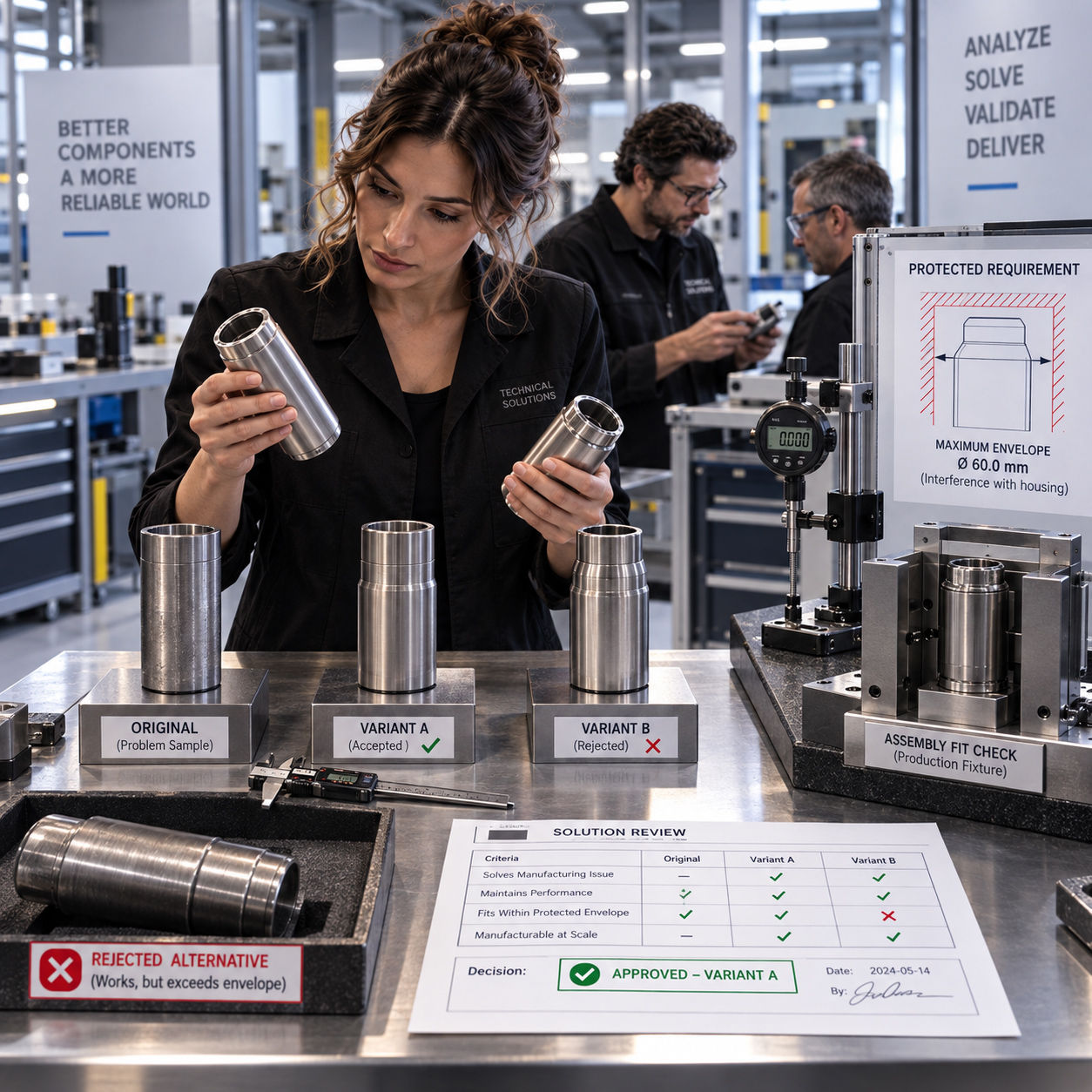
IMPLEMENTATION REVIEW
One Real Constraint — Evaluated Against Performance, Dependencies, And Approval Limits Before The Change Enters Delivery.
The example demonstrates that professional implementation control does not eliminate change. It creates a disciplined method for determining which change preserves the project, which change alters it, and which consequence requires renewed professional judgment before work continues.

IMPLEMENTATION CLOSURE
The Accepted Change Is Reflected In The Physical Result, The Final Revision, And The Verification Record.
A controlled implementation process does not end when a revised solution is approved. The project must confirm that the approved correction is what was actually produced, installed, or released—and that the final technical record now reflects the condition that exists in reality.
IMPLEMENTATION INTEGRITY
A Project Does Not Remain True To Its Intent By Refusing To Change. It Remains True By Changing Deliberately.
Real delivery will always introduce conditions that planning could not fully predict.
The goal is not to eliminate change, but to ensure the project can respond without losing its internal logic.
When reality changes the route, the project should still know:
what must remain protected,
what consequences must be evaluated,
who can approve the change,
how the result will be verified,
and
how the final record will reflect what actually happened.
That is the difference between adaptation and drift.
One responds to reality while protecting intent.
The other allows reality to redefine the project one convenient decision at a time.
REALITY WILL CHANGE THE PLAN.
PROFESSIONAL IMPLEMENTATION CONTROL DETERMINES WHETHER THE PROJECT ADAPTS WITH INTENT OR DRIFTS THROUGH CONVENIENCE.
05 —
CONTINUITY BEFORE KNOWLEDGE DISAPPEARS
WHY IT MATTERS
A project does not stop creating value when delivery ends.
Its decisions may need to be revisited months later. A supplier may change. A component may require replacement. A new team may inherit the system. The project may need adaptation for another market, platform, location, production condition, or future phase.
At that point, the project depends on something easily underestimated during active work:
memory.
While delivery is ongoing, important knowledge often lives between people. Someone remembers why an option was rejected, which tolerance was negotiated, why a substitution was conditionally accepted, or which drawing superseded another.
That knowledge can feel permanent.
It is not.
Projects lose intelligence when important reasoning remains trapped inside conversations, inboxes, personal folders, temporary workarounds, undocumented approvals, and individual memory.
The final files may remain.
But the logic that made them meaningful can disappear.
A future team may therefore inherit the project without inheriting its understanding.
Continuity requires more than storing deliverables. It must preserve enough professional context for another qualified person to determine:
what the final state is,
why important decisions were made,
what changed during implementation,
which deviations were intentionally accepted,
what remains sensitive,
and
where future work should begin.
The goal is not to archive everything.
It is to preserve the critical intelligence that prevents future work from starting in ignorance.
A PROJECT HAS REAL CONTINUITY WHEN ITS KNOWLEDGE REMAINS USEFUL AFTER THE PEOPLE WHO CREATED IT ARE NO LONGER IN THE ROOM.
COMMON FAILURE
THE PROJECT IS DELIVERED, BUT ITS DECISION HISTORY DISAPPEARS
Completion creates a natural pressure to simplify.
The final drawing is saved. The approved component is delivered. The folder is closed. The team moves on.
Yet the archive may still contain unclear revisions, supplier correspondence without conclusions, implementation notes missing from final documentation, accepted deviations buried in email, obsolete references beside current ones, and final files that show what exists without explaining how the project arrived there.
Months later, that ambiguity becomes more expensive.
A future team may find several versions of the same drawing. A replacement supplier may repeat an alternative that already failed. A designer may reopen a deliberately rejected option. An engineer may repeat an investigation the original team already completed. A maintenance decision may rely on an obsolete condition because the final implementation change was never recorded.
Nothing has technically been deleted.
But important project intelligence has still been lost.
That is why an archive can be full and still be professionally incomplete.
Storage preserves files. Continuity preserves meaning.
When A Completed Project Leaves Behind Files But Not A Reliable Memory
WHY THIS EXAMPLE MATTERS
This example shows the project after delivery, when the work is finished and the archive appears complete.
Drawings, revisions, supplier correspondence, change notes, approval records, and the final component all remain.
The weakness becomes visible only when someone tries to reconstruct the project.
The governing revision is unclear. An accepted deviation survives only inside an old implementation note. A rejected supplier alternative remains without its rationale. A physical sample has no clear status. The final drawing shows the delivered geometry, but not the reasoning behind one critical change.
The project therefore contains information without providing a reliable path through it.
A future professional can study the archive.
But they must first reconstruct the project before they can responsibly continue it.
That is exactly what professional continuity should prevent.

WHAT NOT TO DO — Assume That Saving The Final Files Is The Same As Preserving The Project
An archive becomes unreliable when it stores outputs without clarifying which records govern the final state, which changes were intentionally accepted, what previous alternatives were rejected, and what future work must understand before modifying the result.
BETTER
DIRECTION
PRESERVE THE PROJECT STATE SO FUTURE WORK DOES NOT HAVE TO START FROM ZERO
A useful continuity record should not attempt to preserve everything with equal importance.
It should preserve what another qualified person will need in order to resume responsibility intelligently.
That means separating historical material from governing information.
The final project record should make several relationships immediately visible:
Final Approved State
What condition was actually delivered?
Decision Record
Which important decisions explain that result?
Accepted Deviations
Where does the delivered condition intentionally differ from the earlier approved direction?
Rejected Alternatives
Which options were already evaluated and why were they rejected?
Final Technical References
Which drawings, specifications, source files, models, standards, and material references govern the result?
Known Dependencies
What other systems or conditions depend on these decisions remaining intact?
Lessons Learned
What did implementation reveal that future work should not have to discover again?
Future Review Triggers
What types of change should cause the project to return to specialist review?
The objective is not historical perfection.
It is professional recoverability.
A future team should be able to understand the delivered project without repeating the intellectual work that has already been completed.
CONTINUITY
SYSTEM
TURN PROJECT HISTORY INTO A USEFUL PROFESSIONAL REFERENCE
A strong continuity system has to do more than describe the past.
It must make the past useful to the future.
That means the final record should distinguish clearly between:
what was considered,
what was approved,
what changed,
what was actually delivered,
and
what another team should know before changing it again.
The project archive therefore becomes a controlled professional reference rather than a storage location.
Source material can remain available.
Historic revisions can remain available.
Supplier correspondence can remain available.
But the archive also needs a clear layer that tells a future reader where truth currently lives.
This gives future teams a reliable starting point, reducing repeated investigation, unnecessary uncertainty, and decisions made without inherited project context, while preserving clarity across future reviews and decisions.
That may include a final index, governing revision register, accepted deviation record, technical summary, continuity notes, final source-file references, implementation lessons, and future-use guidance.
The result is not bureaucracy.
It is accumulated project intelligence made reusable.
GOOD CONTINUITY PREVENTS TOMORROW’S TEAM FROM PAYING AGAIN FOR KNOWLEDGE THE PROJECT HAS ALREADY EARNED.
When The Final Project Record Preserves Both The Delivered State And The Intelligence Behind It
WHY THIS EXAMPLE MATTERS
The stronger condition uses the same completed project, with the same drawings, supplier history, and implementation changes.
Nothing has been simplified.
The difference is that the project has been formally closed into one legible continuity system.
The archive identifies the governing revision. Accepted deviations are linked to their approvals. Rejected alternatives retain the reason for rejection. The final physical condition is connected to the documentation that describes it, while historical revisions remain accessible but clearly separated from the current state.
The record also preserves what implementation taught the team and which future changes would require renewed review.
A professional returning months or years later therefore does not begin by asking:
“What happened here?”
They can begin with the more useful question:
“What needs to happen next?”
That is the practical value of continuity.

CONTINUITY RECORD
One Delivered Project — Preserved Across Final State, Decision History, Accepted Change, Technical References, And Future Review Conditions.
The model demonstrates how project knowledge becomes durable when the final result is connected to the reasoning, revisions, implementation changes, and technical references required to understand it later.
The archive does not attempt to preserve every moment of the project with equal weight.
It preserves the information necessary for future professional judgment.
When The Project Is Reopened Later — And The Next Decision Does Not Begin From Zero
WHY THIS EXAMPLE MATTERS
Continuity is difficult to judge on the day a project closes.
The team is still available, the decisions are still familiar, and the logic behind them feels obvious.
Its real value appears later.
Imagine the component must be adapted eighteen months after delivery. The original supplier is gone, a new professional enters the project, and one dimensional condition must change.
Without continuity, the team must reconstruct why the original dimension existed, which alternatives were rejected, what implementation revealed, and which dependencies may be affected.
With a controlled continuity record, those questions already have a starting point.
The new specialist can see the delivered state, understand the original reasoning, identify accepted deviations, locate protected dependencies, and determine which part of the new proposal requires renewed review.
The archive has therefore done more than preserve history.
It has reduced the cost, uncertainty, and risk of the next decision.

CONTINUITY IN PRACTICE
Project Knowledge Creates Long-Term Value When A Future Team Can Use It To Make The Next Decision More Intelligently.
The strongest continuity systems do not preserve information simply because it once existed. They preserve enough verified context for future specialists to distinguish history from current truth, understand important dependencies, avoid repeating resolved investigations, and begin new work from a stronger professional foundation.
CONTINUITY INTEGRITY
The Final Deliverable Is Not The End Of The Project’s Intelligence.
A mature project leaves behind more than a completed object, interface, document, installation, or scope.
It leaves behind an understandable record of what was learned.
That record supports change without amnesia, maintenance without reconstruction, new suppliers without lost knowledge, and future phases with greater clarity.
It also allows later specialists to challenge earlier decisions intelligently because they can first understand why those decisions existed.
Continuity does not freeze a project in time.
It gives future change a reliable point of departure.
That completes the relationship between all five areas:
A decision needs reasoning.
Reasoning must survive technical translation.
Technical meaning must survive handoff.
Implementation must adapt without losing intent.
And the knowledge created through those stages must remain available after delivery.
A PROJECT SHOULD NOT FORGET EVERYTHING IT LEARNED THE MOMENT IT IS DELIVERED.
PROFESSIONAL CONTINUITY TURNS COMPLETED WORK INTO A RELIABLE FOUNDATION FOR WHATEVER MUST HAPPEN NEXT.
FROM DECISION QUALITY TO DELIVERY INTEGRITY
A Strong Project Does Not Protect Its Value Once. It Protects It Every Time Information, Responsibility, And Reality Change.
The strongest Consulting & Technical Support systems do more than help a project make one correct decision. They create enough clarity, technical structure, responsibility, implementation control, and continuity for that decision to remain useful as the work moves forward.
A project may begin with a strong idea and still weaken later.
The problem is rarely one obviously bad decision.
More often, value is lost gradually: reasoning is not recorded, technical requirements are translated incompletely, responsibility changes hands without enough context, practical corrections create downstream consequences, and project knowledge becomes scattered across files, revisions, conversations, and individual memory.
Each moment may appear manageable on its own.
Together, they determine whether the project remains coherent.
Across the five areas explored in this article, one principle keeps returning:
decision integrity, technical translation, handoff clarity, implementation control, and continuity are not separate administrative tasks.
They are connected responsibilities within one professional system.
A decision without reasoning becomes difficult to adapt. Reasoning without technical translation remains unusable. Technical information without controlled handoff becomes vulnerable to interpretation. Implementation introduces new constraints. And long-term value disappears if the project forgets what it learned.
That is why professional Consulting & Technical Support is more than advice, documentation, meetings, or troubleshooting.
Its deeper role is to maintain the relationship between intent, technical reality, responsibility, change, and future use.
When those relationships remain visible, teams can understand what matters, what may change, what requires review, what has already been learned, and what the next person needs to continue responsibly.
A PROJECT DOES NOT REMAIN STRONG BECAUSE NOTHING CHANGES.
IT REMAINS STRONG BECAUSE CHANGE DOES NOT ERASE THE LOGIC THAT GIVES THE PROJECT DIRECTION.
THE FIVE DIMENSIONS OF DECISION CONTINUITY
Decision Integrity protects the reason behind the direction. Technical Translation makes that direction usable. Handoff Control preserves meaning when responsibility changes. Implementation Control allows the project to respond to reality without uncontrolled drift. Continuity preserves the intelligence created through all four.
Considered together, these five dimensions create a professional support system capable of maintaining clarity across different people, disciplines, suppliers, revisions, technical constraints, implementation conditions, and future project phases.
A GOOD DECISION MAY CREATE DIRECTION.
THE SYSTEM BETWEEN DECISION AND DELIVERY DETERMINES HOW MUCH OF THAT DIRECTION SURVIVES.
FROM FIVE PROFESSIONAL RESPONSIBILITIES TO ONE CONTROLLED DELIVERY SYSTEM
Key Takeaways
A practical framework for evaluating whether a project is merely moving forward—or whether its decisions, technical logic, responsibilities, changes, and accumulated knowledge remain sufficiently connected to protect value through delivery and beyond.
The five principles explored throughout this article point toward one broader idea:
strong project continuity is created when every professional stage receives enough verified context from the stage before it—and leaves enough useful intelligence for the stage that follows.
These takeaways can be applied when establishing a new project, reviewing an existing one, entering a difficult implementation phase, changing suppliers or teams, resolving technical uncertainty, or preparing completed work for future use.
01 —
DECISION INTEGRITY BEFORE EXECUTION
A strong project should first make clear what has been approved, why that direction was selected, and what objective or requirement the decision is protecting.
Important reasoning should not remain only in the memory of the person who originally made the decision.
The project must preserve enough context for another qualified person to understand what must remain true across every project stage even when circumstances change.
Flexibility becomes safer when the boundaries around the decision are visible.
A decision becomes durable when its reasoning can survive beyond the person who first approved it.
02 —
TECHNICAL TRANSLATION BEFORE HANDOFF
A strategic direction becomes operational only when it is translated into information that other disciplines can use correctly.
Performance requirements, material conditions, dimensions, tolerances, dependencies, alternatives, and review triggers must communicate more than what should be made.
They must preserve what makes the solution valid.
Technical clarity does not eliminate interpretation.
It gives interpretation a reliable professional foundation.
The specification should not merely describe the answer. It should preserve the conditions that make the answer correct.
03 —
HANDOFF CONTROL BEFORE EXECUTION
Responsibility can move faster than understanding.
A professional handoff therefore needs to transfer more than files.
The receiving side should be able to identify the current approved state, open questions, known deviations, protected dependencies, responsible parties, approval limits, and next actions without reconstructing the project from history.
The purpose is not to eliminate professional judgment.
It is to prevent judgment from being used to recover information that should already be explicit.
A handoff succeeds when responsibility changes without creating a new version of the project’s truth.
04 —
EXECUTION CONTROL BEFORE CONVENIENCE
Reality will introduce conditions that drawings, specifications, and planning could not fully predict.
That is normal.
The professional challenge is determining whether an adjustment simply changes the route—or changes the project itself.
Implementation decisions should connect the observed constraint to its wider consequences, dependencies, verification method, approval authority, and updated documentation.
Speed matters.
But speed without consequence awareness creates drift.
Strong implementation does not prevent change. It makes change deliberate, reviewable, and verifiable.
05 —
CONTINUITY BEFORE KNOWLEDGE DISAPPEARS
A project should not lose its intelligence when active delivery ends.
Final state, important decisions, accepted deviations, rejected alternatives, governing technical references, implementation lessons, dependencies, and future review conditions should remain understandable later.
The objective is not to preserve every communication indefinitely.
It is to preserve the information that allows future professional judgment to begin from knowledge rather than reconstruction.
Continuity turns completed work into a stronger starting point for whatever must happen next.
THE STRONGEST PROJECT IS NOT THE ONE THAT NEVER CHANGES. IT IS THE ONE IN WHICH
DECISIONS REMAIN UNDERSTANDABLE, TECHNICAL MEANING REMAINS USABLE, RESPONSIBILITY REMAINS CLEAR, CHANGE REMAINS CONTROLLED, AND KNOWLEDGE REMAINS AVAILABLE LONG AFTER THE ORIGINAL QUESTION HAS BEEN RESOLVED.
FROM INDIVIDUAL DECISIONS TO ONE CONTINUOUS PROFESSIONAL SYSTEM
Consulting & Technical Support Connects Decision Logic, Technical Definition, Handoffs, Execution, And Continuity Into One Controlled Path From Intention To Reality.
The complete model brings together the five professional conditions examined throughout this article—from the reasoning behind an initial decision to the knowledge that remains after delivery.
It is how those documents connect.
A decision record preserves why the direction exists. Technical translation turns that direction into usable conditions. A controlled handoff transfers the current project state with responsibility intact. Implementation review tests it against real constraints. Continuity preserves what changed, what was learned, and what future work must know.
Each stage solves a different professional problem.
Together, they create something more valuable:
a project that can move through people, disciplines, suppliers, revisions, constraints, and time without repeatedly losing its own understanding.
That is the deeper role of professional Consulting & Technical Support.
Not to remain attached to every decision.
Not to replace implementation expertise.
Not to create documentation for its own sake.
But to establish enough clarity, technical control, responsibility, and continuity for the work to remain understandable as conditions evolve.
INTEGRATED CONTINUITY MODEL
One Project — Preserved Across Decision, Technical Translation, Handoff, Implementation, And Future Use.
The final model should demonstrate one continuous project history in which every later stage can still identify the intelligence inherited from the stage before it.
The strongest outcome is not a project with the largest archive or the most elaborate process.
It is a project in which a qualified person can enter at a later point and determine:
what was decided, why it mattered, what changed, what was approved, what was actually delivered, and what must be understood before changing it again.

INTEGRATED CONTINUITY MODEL
One Project — Preserved Across Decision Logic, Technical Definition, Responsibility, Implementation Change, And Future Use.
The complete model shows how professional project intelligence remains connected from the first approved direction to the final delivered condition and the knowledge preserved for whatever must happen next.
CONCLUSION
FROM STRONG DECISIONS TO LASTING PROJECT INTELLIGENCE
Good Projects Preserve Their Value When The Meaning Behind Important Decisions Survives The Entire Journey To Delivery.
Professional Consulting & Technical Support creates its greatest value when clarity does not disappear as the project becomes more complex, more technical, more distributed, and more exposed to real-world change.
A strong decision is important.
But it is only the beginning.
It still has to be translated, transferred, interpreted, tested, adjusted, verified, recorded, and eventually understood by people who may never have been part of the original conversation.
That is why project quality cannot be protected only at the start.
It must be protected between stages—between strategy and specification, specification and supplier, disciplines, approved documentation and physical reality, and delivery and whatever comes next.
Professional continuity gives those transitions structure.
It does not prevent change.
It makes change more intelligible.
It does not remove uncertainty.
It makes uncertainty easier to identify and resolve.
It does not replace professional judgment.
It gives judgment better information.
And it does not make a project permanently dependent on external support.
At its strongest, it leaves the project more understandable, traceable, technically grounded, and capable of moving forward without rebuilding knowledge that should already exist.
A STRONG PROJECT DOES NOT NEED EVERY FUTURE PERSON TO REMEMBER THE ORIGINAL CONVERSATION.
IT NEEDS A PROFESSIONAL SYSTEM STRONG ENOUGH TO PRESERVE WHAT THAT CONVERSATION DECIDED, WHY IT MATTERED, HOW REALITY CHANGED IT, AND WHAT THE NEXT PERSON MUST KNOW TO CONTINUE RESPONSIBLY.